Some links in this guide are affiliate links, if you buy through them we may earn a small commission at no extra cost to you. Here’s our disclosure.
Quick Answer
The best bedroom organization ideas for small spaces give every item a home and use vertical and hidden space first: clear surfaces, double closet hanging space, slide clear bins under the bed, and add wall hooks and shelves. Work in four zones, surfaces, closet, under-bed, floor and walls, one at a time.
A small bedroom has a way of looking messy the moment you set anything down. There's no spare corner for the laundry basket, the nightstand disappears under chargers and water glasses, and the closet is so tight that half your clothes end up draped over a chair. You make the bed and the room still feels cluttered, because every surface is doing double duty and nothing has a real home. Maybe you've scrolled past gorgeous organized bedrooms online and quietly assumed those ideas were written for people with walk-in closets and square footage you'll never have. The frustrating part isn't that you're untidy, plenty of neat people lose to a small room. It's that a tight space punishes every single item that doesn't earn its place, so clutter builds faster and shows more. When the floor plan is fixed, staying organized stops being about willpower and becomes a question of having the right system.
What are the best bedroom organization ideas for small spaces?
The best bedroom organization ideas for small spaces all follow one rule: give every item a designated home, and use vertical and hidden space before you buy anything new. Start by clearing every surface completely, then return only what you genuinely use each day, the lamp, an alarm, maybe one book. Everything else moves to a drawer, a bin, or another room entirely. From there, work upward and outward instead of cramming more onto the floor. Mount a slim shelf above the nightstand to lift books and a glass off the surface. Add hooks or an over-the-door organizer to the back of the door for bags and robes. Slide flat containers under the bed for off-season clothes. Where you can, trade a bulky nightstand for a wall-mounted shelf, which frees the floor and instantly makes the room read larger. The goal is never to add more storage, it's to reduce what needs storing, then place the essentials exactly where they're easy to reach. In a small bedroom, careful editing beats clever gadgets every single time.
How do you organize a small bedroom with a tiny closet or none at all?
Treat the closet as prime real estate and move anything you don't wear regularly out of it. In a small bedroom, a closet works hardest when you double the hanging space with a second tension rod below the first, add a hanging shelf organizer for folded sweaters and jeans, and switch to slim velvet hangers that take a fraction of the width of plastic or wood ones. If you have no closet at all, a compact freestanding garment rack paired with a small dresser can stand in for one without eating much floor space. Store shoes in an over-the-door pocket organizer instead of piling them on the floor, where they make the room feel smaller and harder to clean around. Keep only the current season within easy reach, and box the rest for under-bed storage so your everyday clothes aren't competing with winter coats in July. The principle holds for any tight space: go vertical, keep like items together, label anything you can't see into, and never let the floor become storage by default. A folding chair or a slim bench at the foot of the bed can hide a laundry basket underneath and give you a spot to sit that isn't stealing floor space. Clear floor space is what makes a small room feel calm, so protect it the way you'd protect prime countertop in a tiny kitchen.
What's the smartest way to use under-bed and vertical storage?
Under-bed and wall space are the two biggest sources of hidden storage in a small bedroom, and most people badly underuse both. Under the bed, use low-profile containers for out-of-season clothing, spare bedding, and shoes, a set of clear plastic bins with lids lets you see what's inside without dragging everything out, and rolling versions glide out with a single pull. If your frame sits low to the ground, inexpensive bed risers add several inches of clearance almost instantly. On the walls, floating shelves, a pegboard, or a simple row of hooks turn empty vertical space into real storage for books, small baskets, and the everyday items you'd otherwise pile on a nightstand. Even the area above the door can hold a slim shelf for things you rarely reach for, like extra linens or luggage. The rule of thumb keeps it simple: anything you use weekly stays at arm's height, and anything seasonal goes up high or under the bed. Keep the shelves you can see slightly under-filled, a little breathing room reads as calm, while a wall crammed to the edges just moves the clutter upward. When square footage is fixed and can't grow, the move is always the same, fill the air, not the floor.
How should you divide a small bedroom into zones?
Dividing even a small bedroom into a few clear zones keeps clutter from spreading, because every item knows exactly where it belongs. A bedroom really only needs four working zones, and mapping them out is precisely what the free printable plan below helps you do. Here's a simple zone-by-zone breakdown you can use to work through a small bedroom one area at a time instead of tackling the whole room at once:
| Zone | What lives here | Quick win |
|---|---|---|
| Surfaces (nightstand, dresser top) | Lamp, one book, daily essentials | Clear nightly; one tray corrals small items |
| Closet & clothing | Current-season clothes and shoes | Double the rod, switch to slim hangers |
| Under-bed | Off-season clothes, spare bedding | Clear lidded bins, labeled |
| Floor & walls | Nothing on the floor; hooks and shelves up | Add door hooks and a floating shelf |
Finish one zone before you move to the next, get the nightstand clear before you touch the closet, so you feel a win early and keep the momentum going instead of stalling out halfway through a torn-apart room. The printable breaks each of these zones into a short checklist plus a reset routine, which makes progress visible and helps the room stay organized long after the first big tidy is done.
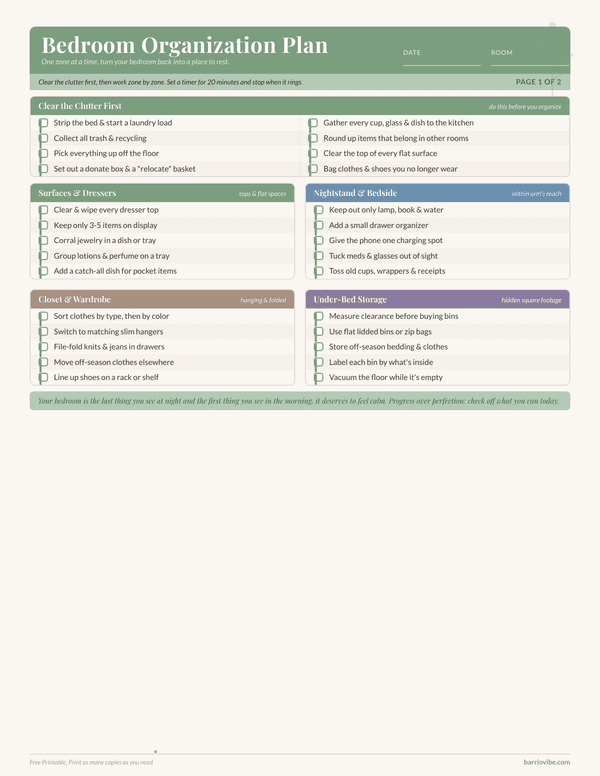
Bedroom Organization Plan, Free Printable
A free printable bedroom organization plan with zone-by-zone checklists for surfaces, nightstand, closet, drawers, and under-bed storage, plus nightly and weekly reset routines to keep your bedroom tidy for good.
How do you keep the nightstand and surfaces clutter-free?
Keep surfaces clear by giving each one a single job and a small container to catch everything else. A nightstand really only needs a lamp, one book, and maybe a coaster, chargers, lip balm, and hair ties belong in a shallow drawer or a small tray, not scattered across the top where they read as clutter the second you walk in. The fastest way to keep a dresser top clean is the one-tray rule: if it doesn't fit in the tray, it goes into a drawer or leaves the room entirely. Build a 60-second surface sweep into your nightly wind-down, returning stray items to their homes before you climb into bed. A small dish or bowl by the door for keys and pocket change stops those things from migrating onto the nightstand in the first place. Because surfaces are the first thing your eye lands on, keeping them clear makes the whole room feel organized even on the days the closet isn't perfect. This is where small bedroom organization quietly succeeds or fails. For the exact nightly habit that makes it stick, our guide to keeping bedroom surfaces clutter-free walks through the reset step by step so it becomes automatic.
How do you keep a small bedroom organized for good?
The bedroom organization ideas for small spaces above only pay off if they stick, and staying organized comes down to a short, repeatable reset rather than another big overhaul. Because there's so little slack in a tight room, clutter shows up fast, but that also means it clears fast once you have a rhythm. Spend about five minutes each night putting clothes away, clearing surfaces, and setting out what you need for the morning. Once a week, do a slightly longer reset: swap the sheets, empty any catch-all baskets, wipe the surfaces, and return anything that drifted in from other rooms during the week. Every season, pull the under-bed bins and rotate your clothing so the closet only ever holds what you're actually wearing right now, and donate the pieces you skipped over entirely last season. A one-in, one-out rule keeps a small space from creeping back to full, when something new comes in, something older leaves. If you want the full walkthrough for a room of any size, our bedroom organization ideas guide covers layout and storage in more depth. Print the plan, work one zone at a time, and let the routine hold the line so the room never gets away from you again.
Bedroom Organization Plan, Free Printable
A free printable bedroom organization plan with zone-by-zone checklists for surfaces, nightstand, closet, drawers, and under-bed storage, plus nightly and weekly reset routines to keep your bedroom tidy for good.
Frequently Asked Questions
How do I organize a very small bedroom?
Clear every surface, then return only daily essentials. Use vertical space with wall shelves and door hooks, slide clear bins under the bed for off-season items, and double your closet's hanging space with a second rod and slim hangers. Work one zone at a time so it never feels overwhelming.
How can I make a small bedroom look less cluttered?
Keep the floor and surfaces as clear as possible, since both are the first things your eye lands on. Store items up on walls or under the bed instead, corral small things in one tray, and remove anything that doesn't belong. Clear floor space instantly makes a small room read larger and calmer.
What can you store under the bed in a small bedroom?
Under-bed space is ideal for off-season clothing, spare bedding, extra pillows, and shoes. Use low-profile clear bins with lids so you can see the contents without pulling everything out, and add bed risers for a few extra inches of clearance if your frame sits low to the ground.
How do you organize a small bedroom with no closet?
Replace the closet with a compact freestanding garment rack plus a small dresser, and go vertical wherever you can. Use slim hangers, an over-the-door shoe organizer, and wall hooks for bags and robes. Keep only the current season out, and box the rest in labeled under-bed bins.
How do I keep my small bedroom organized long-term?
Do a five-minute reset each night, clothes away, surfaces cleared, morning items set out. Once a week swap sheets and empty catch-all baskets, and each season rotate your under-bed clothing bins. Follow a one-in, one-out rule so the small space never creeps back to full.