Some links in this guide are affiliate links, if you buy through them we may earn a small commission at no extra cost to you. Here’s our disclosure.
Quick Answer
The best preschool activities at home are simple, hands-on, and built from things you already own: sorting buttons by color, scoop-and-pour bins, playdough, sticker pages, couch-cushion obstacle courses, and pretend play. Rotate a few across a morning to cover fine motor, language, and gross-motor skills, no craft store or teaching degree required.
By ten in the morning the coloring pages are done, the blocks are dumped across the rug, and your three-year-old is tugging your sleeve asking "what now?", again. You know these years matter, that little brains build fastest right now, and you want to offer more than another episode of cartoons. But you are not a trained teacher. The setups you scroll past look like they take an hour and a craft-store run, and by the third "I'm bored" you are fresh out of ideas and patience. Maybe you have saved activity lists that assumed supplies you do not own, or tried a sensory bin that ended with rice in every corner of the kitchen. It can leave you feeling like everyone else got a manual you never received. The good news is that preschoolers are not hard to entertain well, they are wired to learn from the most ordinary things around them. The gap here is not love or effort. It is having a simple, repeatable plan you can pull from on a plain Tuesday morning, without prep, a Pinterest budget, or a teaching degree.
What are the best preschool activities to do at home?
The best preschool activities at home are simple, hands-on, and built from things you already have in the kitchen and craft drawer. Preschoolers learn through play, so the winners are open-ended activities that invite sorting, pouring, building, pretending, and moving, not worksheets at a desk. A handful that work almost every time:
- Sorting and matching, buttons, pom-poms, or mismatched socks grouped by color or size
- Scoop-and-pour stations, dried beans, rice, or water with cups, spoons, and funnels
- Playdough, paired with cookie cutters, plastic scissors, and a rolling pin
- Sticker and dot-marker pages, for pincer grip and careful placement
- Indoor obstacle courses, couch cushions, pillows, and painter's-tape lines
- Pretend play, a make-believe store, a doctor's kit, or a tea party
Rotate three or four of these across a morning and you cover fine motor, language, and gross-motor skills without a single trip to the store. The goal is not to fill every minute, it is to hand your child a starting point they can run with.
How much structured activity time does a preschooler actually need?
Far less than most parents expect. A preschooler needs only about 20 to 30 minutes of adult-led, structured activity at a stretch, the rest of the day should be free play, outdoor time, meals, and rest. Between ages three and five, attention spans run roughly two to five minutes per year of age, so a four-year-old may stay focused on one guided task for eight to twelve minutes before needing to move. That is completely normal, not a discipline problem. Plan in short blocks: a quick circle-time song, one focused activity, then open play while you reset. Two or three of these mini-blocks across a morning is plenty of learning. Overscheduling backfires, an overstimulated preschooler melts down and absorbs less. When you aim for a few short, intentional pockets instead of a packed lesson plan, the day feels calmer and the activities you do offer actually land.
How do you set up preschool activities at home without spending money?
You can run a full week of preschool activities using only household items, no craft-store haul required. Start with what you already have: dried pasta and beans become sorting and threading materials, plastic containers become scoops and stacking towers, junk mail becomes cutting practice, and a muffin tin becomes a color-sorting station. Save your recyclables, too, cardboard boxes turn into forts, tunnels, and drive-through windows, while bottle caps become counters and stamps. Painter's tape may be the single most versatile supply in the house: use it for hopscotch grids, roads for toy cars, balance beams, and shape outlines on the floor. Keep a small stash of true basics, washable markers, glue sticks, construction paper, and dot markers, and you can improvise almost anything else. The trick is learning to see ordinary objects as open-ended materials. When setup costs nothing and takes two minutes, you actually follow through on the hard mornings.
What skills should preschool activities at home focus on?
Good at-home preschool activities cover five core developmental areas, and the easiest way to plan a balanced week is to touch each one. You do not need all five every day, just rotate so nothing gets ignored. Here is what each area builds, plus a no-prep activity for it:
| Skill area | What it builds | Easy at-home activity |
|---|---|---|
| Fine motor | Hand strength for writing | Threading pasta, playdough, tearing paper |
| Gross motor | Coordination and balance | Obstacle courses, freeze dance, ball toss |
| Language & literacy | Vocabulary, pre-reading | Read-alouds, rhyming games, story retelling |
| Math & logic | Counting, patterns, sorting | Sorting by color, counting snacks, shape hunts |
| Social & emotional | Sharing, feelings, focus | Pretend play, turn-taking games, feelings chart |
Planning by skill area keeps activities purposeful instead of random, and it reassures you that all the "fun stuff" is genuinely covering what preschoolers need before kindergarten. The free printable planner below is organized around these exact five areas, so you can jot one idea per box and see the whole week at a glance.
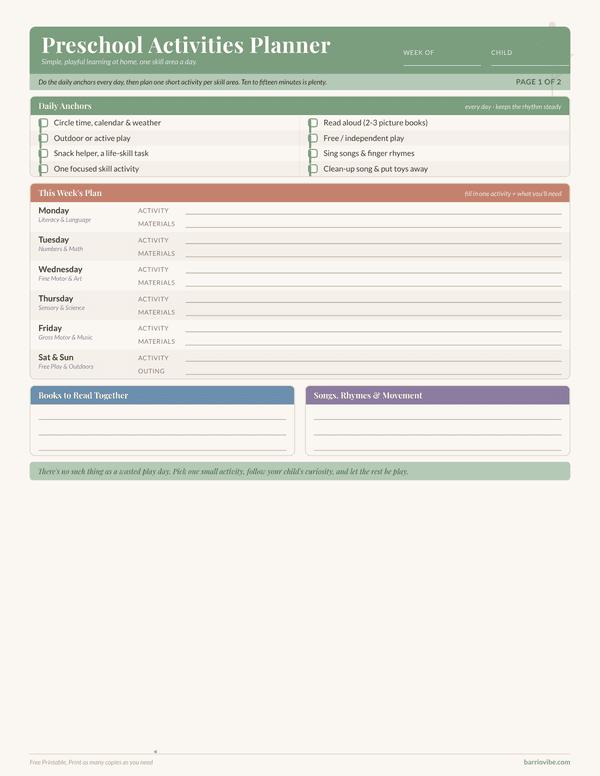
Preschool Activities Planner, Free Printable
A free printable preschool activities planner for learning at home, with a weekly plan organized by skill area plus a no-prep activity idea bank you can check off as you go.
How do you keep preschool activities from turning into chaos?
The secret to calm activity time is containment and rotation, not stricter rules. Set each activity up on a tray or in a shallow bin so the "work" has clear edges, preschoolers focus better when materials have a defined space with an obvious start and finish. Rotate toys and supplies instead of leaving everything out: pack about two-thirds of the toys away and swap them every couple of weeks, and old favorites feel brand new again while cleanup shrinks. Store activity kits in labeled, stackable clear bins so you can grab a ready-to-go station in seconds and your child can see the choices without emptying every shelf. Prep two or three options the night before, so a rough morning never depends on your creativity at 7 a.m. Finally, build a cleanup song into the transition, making tidy-up part of the activity teaches responsibility and signals that one thing is ending before the next begins.
How do you plan a week of preschool activities at home?
Start with a loose weekly theme, then assign one focus skill to each day, so planning takes minutes instead of hours. A theme, say "ocean," "colors," or "farm", ties activities together and makes them easier to dream up, but it is entirely optional. The real backbone is the daily skill focus: fine motor Monday, gross motor Tuesday, literacy Wednesday, math Thursday, and a craft or free-choice Friday. Pick one or two activities per day from your idea bank and you have a full week without repeating yourself. If your child is at the younger end, our guide to preschool activities for 3-year-olds breaks the ideas down by attention span and ability. And when you want to build grip and hand strength before writing, these fine motor activities for little hands slot right into your Monday focus.
Preschool Activities Planner, Free Printable
A free printable preschool activities planner for learning at home, with a weekly plan organized by skill area plus a no-prep activity idea bank you can check off as you go.
Keep the planner somewhere you'll see it, fill in a few ideas each Sunday, and pull from it on the mornings when your brain is empty. You do not have to be creative on demand or fill every hour, you just need a plan ready before the "what now?" arrives.
Frequently Asked Questions
What are good preschool activities to do at home?
Good at-home options are open-ended and hands-on: sorting buttons or socks by color, scoop-and-pour bins with beans or water, playdough, sticker and dot-marker pages, indoor obstacle courses, and pretend play. Rotate a few each morning to cover fine motor, language, and gross-motor skills without any special supplies.
How many hours a day should you do preschool activities at home?
Aim for just 20 to 30 minutes of structured, adult-led activity at a time, in two or three short blocks across the day. The rest should be free play, outdoor time, and rest. Preschoolers focus for only a few minutes per year of age, so short and frequent beats one long lesson.
How do I do preschool at home for free?
Use household items as materials: pasta and beans for sorting, cardboard boxes for building, painter's tape for hopscotch and roads, and a muffin tin for color sorting. Keep basics like markers, glue, and paper on hand, then plan one focus skill per day. A free printable planner keeps it organized at zero cost.
What should a 4-year-old be learning at home?
Focus on five areas: fine motor (cutting, threading), gross motor (balance, coordination), language and literacy (read-alouds, rhyming), early math (counting, patterns, sorting), and social-emotional skills (sharing, naming feelings, taking turns). Touch each one across the week through play rather than drilling worksheets, and skills develop naturally.
How do I keep my preschooler busy without screens?
Set activities up on a tray or in a bin so they have clear edges, rotate toys so a few feel new each week, and prep two or three options the night before. Ready-to-grab stations, sorting, playdough, obstacle courses, pretend play, keep a preschooler engaged far longer than an open toy shelf and no plan.