
Some links in this guide are affiliate links, if you buy through them we may earn a small commission at no extra cost to you. Here’s our disclosure.
Quick Answer
Fine motor activities are hands-on tasks that strengthen the small muscles in the hands and fingers for skills like writing, cutting, and buttoning. Try pinching pom-poms, threading beads, squeezing playdough, and snipping straws, just 10 to 15 minutes a day builds noticeable strength. Download the free printable checklist to track skills.
You hand your preschooler a crayon and the grip looks all wrong, a whole fist wrapped around it, pressing so hard the tip snaps. Buttons defeat them, safety scissors go sideways, and snack time still ends with more yogurt on the shirt than in the mouth. Maybe a teacher mentioned "fine motor skills" at pickup and now you are quietly worried you have missed something. Or maybe you just watch other kids threading beads and stacking blocks while yours loses interest in seconds. It is easy to assume these little hand skills will simply arrive on their own, until the gap starts showing up in getting dressed, holding a pencil, or keeping up in a busy classroom. And the worry compounds, because every dropped spoon and abandoned coloring page starts to feel like proof. The truth is gentler than that. Small-muscle coordination is built through practice, not waiting, and most ordinary days at home already hold dozens of tiny chances to build it that quietly slip by unnoticed. You do not need a curriculum or a shelf of therapy toys, you need a handful of the right little tasks and a way to remember to reach for them.
What are fine motor activities, and why do they matter so much?
Fine motor activities are simple, hands-on tasks that strengthen the small muscles in the hands, fingers, and wrists, the exact muscles a child needs to hold a pencil, use scissors, button a coat, and feed themselves. Unlike gross motor skills, which power running and jumping, these small-muscle skills develop through repetition: pinching, threading, squeezing, and twisting, done over and over. They matter because nearly everything a child does at school and at home runs on them. A weak pincer grasp makes handwriting exhausting; poor hand strength makes zippers and utensils a daily frustration. When those foundations are shaky, kids often avoid the very tasks that would build them, and the gap slowly widens. The encouraging part is that this is one of the most trainable areas of early development. A few minutes of the right fine motor activities each day, woven into normal play, can move a child forward faster than most parents expect.
What are the best fine motor activities for little hands at home?
The best fine motor activities for little hands use everyday objects and target one small skill at a time, pinching, threading, cutting, or squeezing. You do not need special equipment or a Pinterest-perfect setup; you need variety and repetition. Here are reliable favorites, sorted by the skill they build:
- Pincer grasp: picking up pom-poms or dry beans with fingers or tweezers, peeling stickers off a sheet, popping bubble wrap
- Hand strength: squeezing playdough, using a spray bottle, tearing paper into strips, wringing out a wet sponge
- Threading and bilateral coordination: stringing beads or dry pasta, lacing cards, pushing pipe cleaners through a colander
- Cutting and tool use: snipping straws with safety scissors, using kitchen tongs to move cotton balls between bowls
- In-hand manipulation: stacking coins, turning book pages one at a time, buttoning and zipping practice on a spare shirt
Rotate two or three of these a day rather than doing all of them at once, novelty is what keeps little hands engaged. The printable checklist below groups dozens of these ideas by skill, so you can tick off what you have tried and quickly spot which areas still need practice.
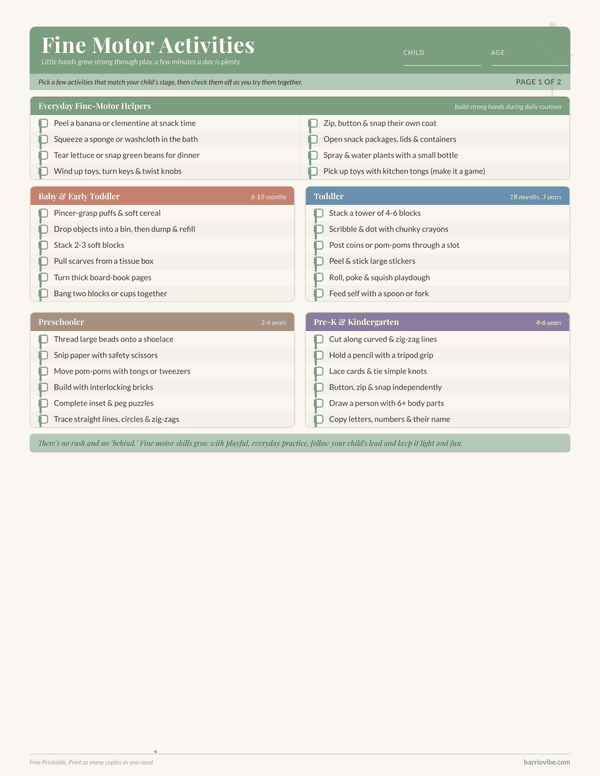
Fine Motor Activities Checklist, Free Printable
A free printable fine motor activities checklist with age-by-age play ideas for babies through kindergarten, plus a weekly practice tracker to check off pinching, cutting, drawing, threading, and self-care skills.
Which everyday household items make the best fine motor tools?
Your kitchen and recycling bin already hold most of what you need, clothespins, tongs, dry pasta, cotton balls, an empty spice jar, and a jar of buttons all make excellent fine motor tools. Clothespins clipped around the rim of a container build pincer strength; tongs turn sorting pom-poms into a game; a plastic lid with a slot cut in it becomes a coin-drop that toddlers will repeat endlessly. The trick is keeping these bits and pieces contained so setup takes seconds, not minutes. A few clear stackable storage bins let you build grab-and-go activity kits, one for threading, one for cutting, one for playdough tools, so a five-minute window never gets lost to hunting for supplies. When the materials are visible and ready, you will actually reach for them. Label each bin by skill, and older siblings can even set up an activity for a younger one without your help. Ready beats perfect every time.
How much fine motor practice do kids really need each day?
Just ten to fifteen minutes of focused hand work a day is enough to build noticeable strength and coordination over a few weeks. Little hands tire quickly, so short and frequent beats long and occasional, three five-minute bursts scattered through the day work far better than one thirty-minute session that ends in tears. The goal is consistency, not intensity. You can also fold practice into things you already do, which is where a checklist really earns its keep. Use this rough guide:
| Age | Daily practice | What it looks like |
|---|---|---|
| Toddler (1-2) | 5-10 min, in short bursts | squeezing, stacking, dropping objects into a container |
| Preschool (3-4) | 10-15 min | playdough, threading, snipping, early scissor work |
| Pre-K / K (4-6) | 15-20 min | cutting shapes, tracing, buttoning, beginning to write letters |
Let your child squeeze the sponge while you wash dishes, tear lettuce for dinner, or peel their own banana, these count. Watch for signs of fatigue and stop before it becomes a battle. The right amount is simply the amount your child can do happily.
What are the signs your child needs more fine motor practice?
The clearest signs a child needs more fine motor practice show up in everyday tasks: an awkward, fisted pencil grip, avoiding coloring or cutting, trouble with buttons and zippers, spilling from utensils, or hands that tire and give up quickly. You might also notice a strong preference for gross-motor play and active resistance to anything requiring careful hand work. None of these mean something is wrong, small-muscle skills develop across a wide, normal timeline, and plenty of capable kids are simply late to this particular party. What they do mean is that a little targeted practice will help. Start with activities set just below your child's frustration point so they feel successful, then gently raise the challenge as their confidence grows. If a child is well past age-typical milestones, for example, cannot hold a crayon at all by age three or four, or shows a strong hand preference before twelve months, it is worth mentioning to your pediatrician or asking about an occupational therapy screening. Trust your gut, but do not let a checklist of worries steal the joy from ordinary play. For the vast majority of kids, a bit more daily hand work, offered as a game, never a test, is all that is needed to close the gap.
How do you make fine motor activities fun instead of a chore?
Fine motor activities work best when they do not feel like practice at all, the moment it turns into a drill, little hands shut down. Lean into play: turn sorting into a timed race, hide beads inside a ball of playdough for a treasure hunt, or let your child "feed" pom-poms into a container with a silly face taped on the front. Follow their interests, too, a dinosaur-obsessed toddler will happily dig plastic dinosaurs out of a bin of dry rice for twenty minutes. Offer small choices so they feel in control, keep each session short enough to end on a high note, and celebrate effort instead of the finished result. Pairing hand work with something they already love is the whole secret. If you are building a broader routine, our fine motor activities for toddlers guide breaks ideas down for the youngest hands, while the fine motor activities for preschoolers list steps things up for ages three to five. Keep the printable checklist nearby and let your child pick what looks fun today.
Fine Motor Activities Checklist, Free Printable
A free printable fine motor activities checklist with age-by-age play ideas for babies through kindergarten, plus a weekly practice tracker to check off pinching, cutting, drawing, threading, and self-care skills.
Tick off what you try, notice which skills need a little more love, and let everyday play do the quiet, steady building, one small, happy handful at a time.
Frequently Asked Questions
What are examples of fine motor activities?
Fine motor activities include picking up pom-poms with tweezers, threading beads or dry pasta, squeezing playdough, snipping straws with safety scissors, peeling stickers, using tongs to sort objects, and buttoning or zipping practice. Each targets the small hand muscles kids need for writing and self-care.
At what age should you start fine motor activities?
You can start simple fine motor activities in infancy with grasping and dropping objects, but they become most useful between ages one and six. Toddlers benefit from squeezing and stacking, while preschoolers move on to threading, playdough, and early scissor work as their hand strength grows.
How much fine motor practice does a child need each day?
About 10 to 15 minutes a day is enough to build noticeable strength over a few weeks. Little hands tire fast, so three short five-minute bursts work better than one long session. Fold practice into everyday tasks like tearing lettuce or squeezing a sponge to make it effortless.
What are signs of weak fine motor skills?
Common signs include an awkward or fisted pencil grip, avoiding coloring and cutting, trouble with buttons and zippers, spilling from utensils, and hands that tire quickly. These usually just mean a child needs more practice, but mention major delays to your pediatrician.
Do I need special toys for fine motor activities?
No. Most of the best fine motor tools are already in your kitchen and recycling bin, clothespins, tongs, dry pasta, cotton balls, buttons, and playdough. Keeping a few clear bins of grab-and-go supplies makes it easy to reach for an activity in a spare five minutes.