
Some links in this guide are affiliate links, if you buy through them we may earn a small commission at no extra cost to you. Here’s our disclosure.
Quick Answer
A garage storage system works by getting everything off the floor and sorting it into activity zones, tools, lawn and garden, sports, seasonal, automotive, and bulk household. Go vertical with wall and ceiling storage, keep daily items at eye level, and contain everything in labeled clear bins. Download the free printable zone plan to map it out.
You pulled into the driveway again, not the garage, because there is no room for the car in there. Somewhere under the bikes, the half-empty paint cans, and the boxes you have not opened since the last move are the tools you actually need, and you have no idea which pile they are in. Every few months you spend a Saturday shoving things around, and within weeks it looks exactly the same. The garage has quietly become the room where everything with no other home ends up: sports gear, holiday decorations, hardware, lawn equipment, and a graveyard of "might need it someday." It is the largest storage space in most homes and almost always the least organized. If you feel a small wave of dread every time that door rolls up, you are not disorganized, you are missing a system.
What is the best way to set up a garage storage system?
The best garage organization storage system starts by getting everything off the floor and sorting it into zones by how you actually use it. Before you buy a single shelf, pull everything out, group like with like, tools, sports, seasonal, lawn and garden, automotive, and bulk household, and be ruthless about what leaves. A garage storage system works because it gives every category a dedicated home on the walls and overhead, freeing the floor for your car and the projects you do standing up. The three moves that matter most: go vertical, because walls and ceilings hold far more than floor stacks; store by frequency, keeping daily-use items at eye level and seasonal things up high; and contain everything in labeled bins so a category never spreads. Do those three things and the garage stops being a dumping ground and becomes usable square footage again. Sort first, install second, the order saves you money and rework.
How do you divide a garage into storage zones?
Divide your garage into five or six zones based on activity, then assign each zone a wall or corner so related items live together. Zoning is the backbone of any garage storage system, it turns a wall of random shelving into a map you and your family can actually follow. Group by what you do, not just what you own: the tools you reach for weekly should not share a shelf with holiday decorations you touch twice a year. Here is a simple zone-by-zone layout that fits most two-car garages:
| Zone | What lives here | Where to put it |
|---|---|---|
| Tools & workbench | Hand tools, power tools, hardware | Wall near the side door |
| Lawn & garden | Rakes, mower, hose, potting supplies | Corner by the main door |
| Sports & outdoor | Bikes, balls, camping gear | Overhead racks + wall hooks |
| Seasonal & holiday | Decorations, off-season items | High shelves or ceiling |
| Automotive | Oil, washer fluid, car care | Low cabinet, out of sight |
| Bulk & household | Paper goods, pet food, overflow pantry | Enclosed shelving |
Map your zones before you mount anything, it is the difference between a system and a pile.
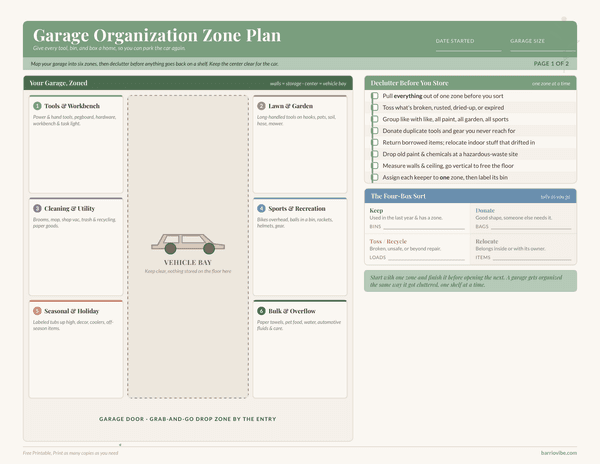
Garage Organization Zone Plan, Free Printable
A free printable garage organization zone plan that maps your garage into six storage zones, plus a declutter-before-you-store checklist, cut-out bin and shelf labels, and a what-goes-where inventory tracker.
Should you store things on the walls, ceiling, or floor?
Use the walls for what you reach for often, the ceiling for what you rarely touch, and keep the floor almost empty. The single biggest mistake in garage organization storage is stacking everything on the ground, where it blocks the car, traps dust, and turns into an archaeological dig. Walls are prime real estate: a slatwall, pegboard, or track system with hooks holds tools, bikes, ladders, and garden gear at eye level where you can grab them in seconds. The ceiling is your deep-storage attic, overhead racks are perfect for seasonal bins, camping gear, and empty luggage you need maybe twice a year. Reserve the floor for large rolling items only: the mower, the trash bins, and of course the car. A good rule of thumb is that anything lighter than about forty pounds should live on a wall or overhead, not on the concrete. Lift it up and the whole space finally breathes.
What are the best storage products for a garage?
The best garage storage products are heavy-duty wall systems, overhead racks, and clear stackable bins, in that order of impact. Start with a wall-mounted track or slatwall system, because getting items vertical does more for a garage than any other single purchase. Add one or two overhead ceiling racks for seasonal storage. Then contain the small stuff: a set of stackable, weatherproof clear bins keeps screws, holiday lights, and sports gear visible and dust-free, and clear sides mean you never have to open five boxes to find one thing. Label every bin, a simple label maker turns a good system into one the whole family can maintain, because when everything is named, everything gets put back. Skip cardboard boxes entirely; they sag, attract pests, and hide their contents. You do not need to buy it all at once, install the walls first, then add bins as you sort each zone.
How do you keep the garage organized after you set it up?
Keep a garage organized by giving every item a labeled home and doing a ten-minute reset each season. A storage system only stays useful if things go back where they belong, so the labels you add during setup are what protect it long term, no one has to guess, and clutter has nowhere to quietly pile up. Build in a quarterly walk-through: pull anything that drifted onto the floor back into its zone, toss what you have not used, and re-home seasonal bins as the calendar turns. Keep a small donate box in one corner so outgrown gear leaves instead of migrating to a shelf. If you are still gathering inspiration, our roundup of garage organization ideas pairs well with this plan, and when budget is the sticking point, these ways to organize your garage on a budget show how to build the same system for less. Maintenance beats overhaul every time.
Where should you start if your garage is already a disaster?
Start by clearing the floor and sorting everything into four staging piles: keep, donate, relocate, and trash. Do not try to organize and purge at the same time, pull it all out onto the driveway first so you can see what you actually have, then make fast decisions. Handle it in one focused weekend or a few evenings: empty the space, sort into piles, get rid of the donate and trash loads immediately so they cannot creep back, and only then install your wall systems and shelving. Work zone by zone rather than perfecting the whole garage at once, and finish each zone before starting the next so you always have a done section keeping you motivated. A written plan keeps you from stalling halfway. Map your zones, list your storage needs, and sketch where each one goes on the free printable below, then work the plan one corner at a time.
Garage Organization Zone Plan, Free Printable
A free printable garage organization zone plan that maps your garage into six storage zones, plus a declutter-before-you-store checklist, cut-out bin and shelf labels, and a what-goes-where inventory tracker.
Pin the plan up where you can see it, tackle one zone at a time, and give the car its spot back. A garage you can actually walk through is built one labeled bin at a time.
Frequently Asked Questions
How do I organize my garage on a budget?
Start with what you already own: sort everything into zones and purge before buying anything. Then add storage in order of impact, a wall track or pegboard first, then a few overhead racks, and clear bins last. Buy bins gradually as you finish each zone rather than all at once.
What is the best way to store things in a garage?
Store by frequency and go vertical. Keep daily-use tools on the walls at eye level, put seasonal bins on overhead ceiling racks, and reserve the floor for large rolling items like the mower and the car. Contain small items in labeled clear bins so nothing spreads.
How do I get my garage organized where I can park in it?
Clear the floor first. Move everything onto walls and overhead racks, reserving the ground only for the car and large rolling equipment. Map parking space before you install storage, mount shelving high enough to clear an open car door, and keep a walkway on each side.
What should you not store in a garage?
Avoid storing anything sensitive to heat or humidity: paint, propane, paper documents, canned food, electronics, and pet food that attracts pests. Extreme garage temperatures can ruin these items or create hazards. Keep them in climate-controlled space and reserve the garage for tools, gear, and durable goods.
How much does a garage storage system cost?
It ranges widely. A budget setup using a pegboard, basic shelving, and clear bins can run under 150 dollars, while a full slatwall and overhead-rack system can reach several hundred. Build in stages, walls first, bins as you sort, so you spread the cost and only buy what each zone needs.