
Some links in this guide are affiliate links, if you buy through them we may earn a small commission at no extra cost to you. Here’s our disclosure.
Quick Answer
Organize a garage on a budget by decluttering first, then dividing the space into zones and going vertical with cheap hooks, pegboard, and repurposed shelves. Skip pricey modular systems, group like items, contain them in matching clear bins you already own or buy secondhand, and label everything so it stays put.
You pull into the driveway, tap the opener, and there it is again, the wall of bins you meant to sort, the bikes leaning against the lawn mower, the bags of who-knows-what stacked on a folding table you can no longer reach. Maybe you have been parking outside for months because the car simply does not fit anymore. Every few weekends you promise yourself you will finally deal with it, but the moment you start, the sheer volume stops you cold. And the price tags on those slick garage systems online do not help: slat walls, powder-coated cabinets, overhead racks, all of it costing more than a car payment. Some days you would rather keep the door shut than let a neighbor catch a glimpse inside. So the door rolls back down, the pile stays exactly where it was, and the guilt rides along with it into the week. If your garage has quietly become the room where household clutter goes to hide, you are not lazy, and you are certainly not the only one.
What are the cheapest ways to organize a garage?
The best garage organization ideas cheap enough to finish in one weekend all share a single principle: go vertical and reuse what you already own instead of buying a system. Budget garage organization really comes down to three moves, get everything up off the floor, group like items together, and contain them in free or low-cost bins. Before you spend a dollar, shop your own house first. Sturdy cardboard boxes, an old dresser headed for the curb, coffee cans, and mismatched glass jars all become storage. Then add height: a single sheet of pegboard, a few reclaimed 2x4s screwed into the studs, or a cheap pack of utility hooks from the hardware store turns bare wall space into hanging storage for rakes, hoses, and extension cords. Repurpose a bookshelf for paint cans and an over-the-door shoe organizer for spray bottles. The goal is not a showroom garage; it is a floor you can cross and a car that finally fits.
Where should you start when the garage feels overwhelming?
Start by pulling everything out and sorting it into four piles before you try to organize a single shelf. The reason a garage feels impossible is that most people attempt to tidy around the clutter instead of clearing it out first. Pick a dry morning, drag everything onto the driveway, and sort ruthlessly into four groups: keep, donate, sell, and trash. Be honest about duplicates, rusted tools, dried-out paint, and the hobby gear you have not touched in three years. Every item you remove is one you never have to store, buy a bin for, or clean around again. Next, group the keepers by how you actually use them, lawn and garden, hand tools, sports, seasonal decor, and automotive. Only now, standing on an empty floor beside sorted piles, can you see how much storage you truly need, which is what stops you from overbuying. This declutter-first step costs nothing and is the biggest reason cheap garage makeovers succeed.
How do you divide a garage into zones on a budget?
Divide the garage into zones by grouping similar items and giving each group its own dedicated wall or corner. Zoning is completely free, and it is what keeps a budget garage organized long after the initial cleanout, because every category has an obvious home and clutter has nowhere to quietly pool. Walk the space and assign each wall a job before you hang a single hook. Heavy, daily-use items belong low and within easy reach; light, rarely used things go up high. A simple, low-cost zone plan usually looks like this:
| Zone | What lives here | Cheap storage idea |
|---|---|---|
| Lawn & garden | Rakes, hose, shovels, plant pots, potting soil | Screw-in wall hooks plus a repurposed trash can for long handles |
| Tools & hardware | Hand tools, screws, nails, tape, glue | A sheet of pegboard over the workbench and labeled glass jars |
| Sports & outdoor | Bikes, balls, helmets, camping gear | A bungee-cord "net" strung across a corner and a laundry basket |
| Seasonal & decor | Holiday bins, coolers, extra folding chairs | Stacked clear bins on a reclaimed bookshelf, heaviest on the bottom |
| Automotive & cleaning | Motor oil, rags, wax, spray bottles | An old kitchen cabinet or dresser rescued from the curb |
Sketch the zones on paper before you move anything, with cheap garage organization ideas, it costs nothing to slide a box around a diagram twice instead of dragging it across the concrete twice. For a printable version you can hang on the wall, our garage organization ideas and zone plan lays out the same map.
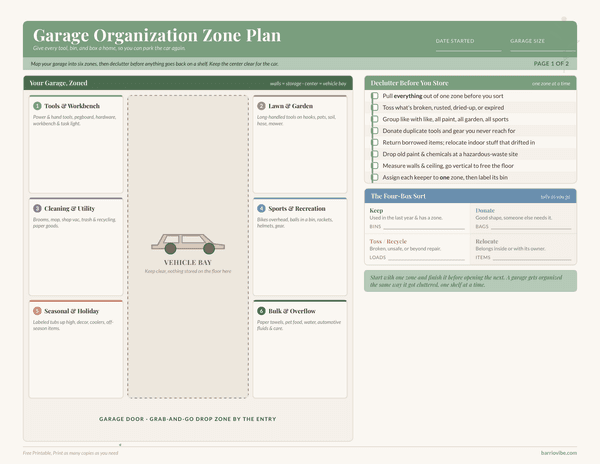
Garage Organization Zone Plan, Free Printable
A free printable garage organization zone plan that maps your garage into six storage zones, plus a declutter-before-you-store checklist, cut-out bin and shelf labels, and a what-goes-where inventory tracker.
What cheap storage containers actually work in a garage?
Clear plastic bins with tight-fitting lids are the single most useful budget buy for a garage, because you can see what is inside without opening and restacking every box. Skip the expensive modular cabinet systems and build around a few workhorses instead. A set of matching clear storage bins keeps seasonal gear stackable, pest-resistant, and easy to label, buy them all in one size so they stack evenly and you can add more later without ending up with a wobbly, mismatched tower. Beyond bins, a roll of painter's tape and a permanent marker make instant, rewritable labels; five-gallon buckets corral long-handled tools; and a cheap magnetic strip holds metal hand tools right on the wall. Repurpose glass jars for screws and nails, and hang a pocket shoe organizer for gloves and spray bottles. With a budget garage, consistency beats quantity: a dozen identical bins on a plain shelf work far better than a heap of random containers.
How do you use wall and ceiling space without spending much?
Use your walls and ceiling first, because vertical space is the cheapest square footage in the whole garage and it is usually sitting completely empty. Every item you hang is one less thing crowding the floor and blocking the car. Start with the walls: pegboard, a wall-mounted broom-and-tool rack, or a simple row of screw-in J-hooks holds rakes, brooms, ladders, and folding chairs for just a few dollars. Bikes can hang from inexpensive vertical hooks or a horizontal bungee sling. Then look up. The space above the garage door and along the ceiling is perfect for light, seasonal items, lay a sheet of plywood across the ceiling joists to create a free overhead shelf for holiday bins and camping gear. Keep heavy or daily items low and lighter, rarely used things high. If you want the full build-out, our garage storage system plan shows how to layer wall and overhead storage step by step.
How do you keep a budget garage organized long-term?
Keep a budget garage organized by labeling every zone and running a quick ten-minute reset each season. Garages slide back into chaos because items get set down wherever there is space rather than returned to a home, and labels are the cheap cure. When every bin, hook, and shelf is clearly marked, everyone in the house knows where things belong, so putting away becomes automatic instead of a decision. Add a simple one-in-one-out rule for gear: when a new tool comes in, an old one goes out, so the space never silently refills. Twice a year, in spring and fall, walk the zones for ten minutes, re-sort anything that drifted, and pull a few things to give away. Keep a donation box in one corner year-round so decluttering never has to be a big event. None of this costs money, a cheap garage stays organized because the system is simple enough to actually keep up with.
You do not need a five-figure garage system to take the space back, you need a clear floor, a handful of labeled zones, and a plan you will actually follow. Start with one wall this weekend, print the zone plan below, tape it up where you can see it, and check off a single zone at a time until the car finally rolls back in.
Garage Organization Zone Plan, Free Printable
A free printable garage organization zone plan that maps your garage into six storage zones, plus a declutter-before-you-store checklist, cut-out bin and shelf labels, and a what-goes-where inventory tracker.
Frequently Asked Questions
How do you organize a garage on a budget?
Declutter everything into keep, donate, sell, and trash piles first, then divide the space into zones like lawn, tools, sports, and seasonal. Go vertical with cheap hooks and pegboard, reuse shelves and jars you already own, and contain the rest in matching clear bins. Label each zone so it stays organized.
What is the cheapest way to add garage storage?
Wall and ceiling space is the cheapest storage you have because it is usually empty. A pack of screw-in J-hooks, a single pegboard sheet, or a plywood shelf laid across the ceiling joists costs just a few dollars and gets rakes, bikes, and seasonal bins up off the floor and out of the way.
How do I organize my garage when it's a total mess?
Pull everything out onto the driveway on a dry day and sort ruthlessly before organizing anything. Clearing the clutter first lets you see the floor and judge how much storage you actually need. Then group the keepers by how you use them and assign each group its own wall or corner so returns are obvious.
Are clear plastic bins good for garage storage?
Yes, clear bins with tight lids are the best budget buy for a garage because you can see the contents without unstacking every box, and the lids keep out dust and pests. Buy them all in one size so they stack evenly and you can add more later without a wobbly, mismatched tower.
How do I organize a garage without buying shelves?
Reuse what you already own and go vertical. An old dresser, bookshelf, or kitchen cabinet headed for the curb becomes free storage, while wall hooks, pegboard, glass jars, and five-gallon buckets hold tools and long-handled gear. Group items into zones and label them so the space stays tidy without spending on shelving.