
Some links in this guide are affiliate links, if you buy through them we may earn a small commission at no extra cost to you. Here’s our disclosure.
Quick Answer
The best fine motor activities for preschoolers are simple pinch-and-grip tasks: threading pasta, using tongs to move pom-poms, rolling playdough, snipping paper, and clipping clothespins. Aim for 10 to 20 minutes of playful practice a day, in short bursts, to build the hand strength behind writing, cutting, and buttons.
Your preschooler can spot a favorite snack across a crowded kitchen but can't quite work the zipper on their own jacket. They grip the crayon in a fist, snip the air instead of the paper, and hand you the buttons with a frustrated sigh. Maybe a teacher mentioned "fine motor skills" at pickup, or you noticed other kids at the table holding a pencil in a way yours doesn't yet. So you bought the pricey threading toy, and it sat in the bin after ten minutes, ignored by dinnertime. It's easy to worry you're either pushing too hard or not doing enough, to compare your child to the kid down the street, and to have no real idea which small things actually move the needle. The good news is that the skills behind buttons, scissors, and handwriting aren't built by expensive kits or worksheets drilled at the table. They're built by tiny, repeatable moments of play scattered through an ordinary day. You just need to know which moments count, and that's exactly what this guide walks you through.
What are the best fine motor activities for preschoolers?
The best fine motor activities for preschoolers are simple, hands-on tasks that make small muscles in the fingers and hands pinch, squeeze, twist, and grip. Think threading pasta onto a string, using kid-safe tongs to move pom-poms into an ice tray, tearing paper for a collage, rolling and pinching playdough, stacking coins, peeling stickers, and snipping strips of paper with child scissors. These beat most battery-powered toys because they demand a real pincer grasp, thumb and forefinger working together, which is the exact motion behind holding a pencil and fastening a button. The secret is variety and low pressure: rotate a handful of activities so hands work in different ways, and keep each one short. A three- or four-year-old builds strength through repetition across weeks, not one long session. Aim for playful and frequent, and the skills follow naturally.
Why do fine motor skills matter before kindergarten?
Fine motor skills matter before kindergarten because so much of a school day quietly depends on them. Kindergarten asks children to hold a pencil and form letters, cut along a line with scissors, glue and paste, manage buttons and zippers after bathroom trips, open lunch containers, and turn book pages one at a time. A child who hasn't built hand strength and coordination can fall behind not because they lack ability, but because the physical act of writing tires them out before they can show what they know. Strong fine motor skills also support focus and independence, a kid who can dress and feed themselves feels capable and spends less of the day waiting for help. Occupational therapists consistently point to hand strength and pincer control as foundations for early writing. Building those muscles now, through play, means your preschooler walks into kindergarten ready to do the hands-on work without frustration.
Which everyday household items build fine motor skills?
Everyday household items are often better fine motor tools than store-bought toys, because they're free, familiar, and endlessly rotatable. You almost certainly have most of these already:
| Household item | Fine motor skill it builds |
|---|---|
| Clothespins clipped to a bowl rim | Pincer strength and hand endurance |
| Dry pasta + shoelace or yarn | Threading and hand-eye coordination |
| Kitchen tongs + cotton balls | Grip control and bilateral coordination |
| Playdough or bread dough | Squeezing, rolling, finger strength |
| Stickers peeled and placed | Fingertip precision |
| Cheerios pushed onto a spaghetti stand | Pincer grasp and focus |
| Buttons or coins into a slotted lid | Two-finger pinch and release |
Keep a rotating stash of these in a few clear bins so you can grab one during the ten minutes before dinner without hunting for supplies. Set out one or two options at a time rather than everything at once, a smaller choice keeps a preschooler focused instead of overwhelmed, and swapping the bin's contents weekly keeps the "old" activities feeling new.
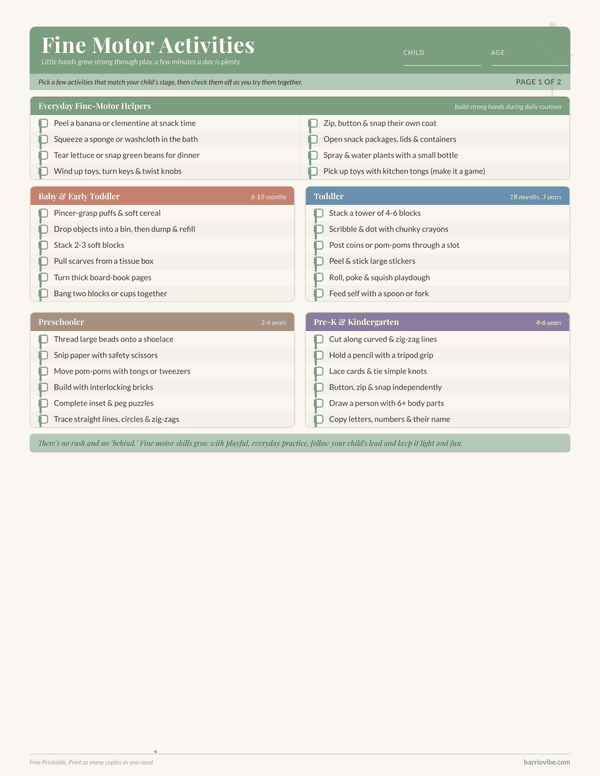
Fine Motor Activities Checklist, Free Printable
A free printable fine motor activities checklist with age-by-age play ideas for babies through kindergarten, plus a weekly practice tracker to check off pinching, cutting, drawing, threading, and self-care skills.
How much fine motor practice does a preschooler need each day?
A preschooler needs only about 10 to 20 minutes of fine motor play a day, and it doesn't have to happen all at once. Short, frequent bursts work far better than one long, forced session, because little hands fatigue quickly and a tired, frustrated child stops building skills and starts building resistance. Fold the practice into moments you already have: threading a few beads while you cook, snipping paper during quiet time, or squeezing playdough after lunch. Two or three five-minute pockets across the day easily add up, and they slip in without feeling like a scheduled lesson. Consistency matters far more than duration; a few focused minutes most days beats a rushed marathon once a week. Watch your child for the real cue to stop, when the pinching gets sloppy or they drift off to something else, the muscles are done for now, and pushing past that point only sours the whole activity and makes tomorrow harder. Keep it light, keep it regular, and let their attention set the pace.
How do you make fine motor activities feel like play, not homework?
You make fine motor activities for preschoolers feel like play by hiding the "skill" inside a game, a story, or a job your child actually wants to do. Kids resist anything that smells like a drill, but they'll happily "feed the hungry monster" by dropping pom-poms into a container's mouth, or "rescue the animals" frozen in a block of ice with tongs. Give tasks a purpose: let them tear lettuce for the salad, peel the sticker price tags, or clip the chip bags closed, real work builds real hands and real pride. Follow their interests, too. A dinosaur-obsessed kid will bury and dig tiny figures out of playdough far longer than they'll poke it on command. Offer, don't require: set the activity out invitingly and let them choose it. And celebrate effort, not perfection, "you worked so hard to get that button through" keeps them coming back tomorrow. When it feels like fun instead of a chore, they practice more, come back to it willingly, and the skills stick without a single tear.
What if your preschooler avoids or struggles with fine motor tasks?
If your preschooler avoids or struggles with fine motor tasks, start easier and shorter rather than pushing harder. Frustration usually means the activity is a step too advanced, so drop back to something that guarantees a small win, fat crayons instead of thin ones, tearing paper before cutting it, or chunky beads before tiny ones. Build hand strength with big, whole-arm play first: squeezing sponges in the bath, kneading dough, and climbing all wake up the muscles that fingers rely on. Sit alongside and do it with them so it feels like connection, not a test, and keep sessions to a minute or two at first. Progress at this age is uneven, and most kids catch up with gentle practice. That said, if by age four or five your child can't grip a crayon, shows no interest in using their hands, or seems to struggle far more than peers, mention it to your pediatrician, an occupational therapy screening is simple and reassuring.
Our fine motor activities for toddlers printable covers the earlier building blocks, and these 20 preschool activities to do at home fold hand-strengthening play into a fuller day.
Fine Motor Activities Checklist, Free Printable
A free printable fine motor activities checklist with age-by-age play ideas for babies through kindergarten, plus a weekly practice tracker to check off pinching, cutting, drawing, threading, and self-care skills.
Frequently Asked Questions
What age should a child have good fine motor skills?
Fine motor skills develop gradually from infancy, but most children refine a pincer grasp and can manage crayons, chunky scissors, and large buttons between ages three and five. Development is uneven, so focus on steady progress through play rather than hitting an exact milestone by a set birthday.
What are examples of fine motor skills for preschoolers?
Examples include holding a crayon or pencil, cutting with scissors, threading beads, stacking blocks, buttoning and zipping clothes, using a fork and spoon, turning book pages one at a time, opening containers, and pinching small objects like coins or Cheerios between thumb and forefinger.
How can I improve my preschooler's fine motor skills at home?
Offer short, playful pinch-and-grip tasks daily: playdough, tongs and pom-poms, threading pasta, peeling stickers, and snipping paper with kid scissors. Use household items, keep sessions to a few minutes, follow your child's interests, and praise effort over neatness to keep them practicing willingly.
Are fine motor skills a sign of intelligence?
Fine motor skills are not a direct measure of intelligence, but they support learning by making writing, cutting, and self-care easier, which frees a child to focus in class. Strong hand skills help kids show what they know without being held back by physical frustration.
When should I worry about my preschooler's fine motor skills?
Mention it to your pediatrician if by age four or five your child cannot grip a crayon, shows no interest in using their hands, avoids all fine motor play, or struggles far more than peers. A simple occupational therapy screening can rule out concerns and offer easy strategies.