Some links in this guide are affiliate links, if you buy through them we may earn a small commission at no extra cost to you. Here’s our disclosure.
Quick Answer
A classroom rules printable turns vague expectations into three to five short, positive rules kids can read and remember, like Be kind, Be safe, and Be ready. Phrase each as an action, match every sign to one theme and color palette, and post them at kid eye level where the behavior happens.
The first week is coming, and your walls are still bare. You have a theme in your head, maybe sage and kraft paper, maybe rainbow brights, but every free download you find is a mismatched jumble of fonts and clip art that fights whatever you already put up. Meanwhile the rules themselves feel just as slippery: you know you need them posted, you know kids will test every one, and you know a laminated list means nothing if the class never buys in. So you keep scrolling, tab after tab, trying to reconcile "cute" with "clear" with "actually gets followed," and the clock keeps ticking toward day one. It is a strangely stressful little corner of setup, part decorating, part classroom management, part graphic design you never signed up for. The good news is that all three problems have the same fix, and it starts with getting the words right before you worry about the borders.
How do you write classroom rules that kids actually follow?
Write three to five short rules, phrase every one as what to do instead of what to stop, and post them where students can see them all day. A good classroom rules printable does this for you: it turns vague expectations into a handful of concrete, positive statements kids can read, remember, and repeat back. Aim for rules broad enough to cover many situations, "Be kind," "Be safe," "Be ready", so you are not policing a list of twenty specifics. Keep the language at or below your students' reading level, use first person or "we" to build ownership, and pair each rule with a picture cue for early readers. The number matters: more than five and no one remembers them; fewer than three and they feel arbitrary. Rules kids follow are the ones they helped shape, understand completely, and see every single day, not the ones buried in a syllabus.
What are the best classroom rules to post for the year?
The best classroom rules are few, positive, and broad enough to fold in almost any specific behavior. Rather than reinventing them, most teachers adapt a short core set and let the class discuss what each looks like in practice. Here is a proven starter set, why it works, and what it covers:
| Rule (positive phrasing) | Why it works | What it replaces |
|---|---|---|
| Be kind | Covers words, hands, sharing, and listening | "No hitting / no name-calling" |
| Be safe | One phrase for the whole room and hallway | "Don't run / keep chairs down" |
| Be ready | Materials, seat, and attention in one idea | "Stop being late / bring your pencil" |
| Be respectful | Extends to people, property, and space | "Don't grab / don't interrupt" |
| Do your best | Sets an effort standard, not a talent one | "No giving up / try harder" |
Notice each rule is stated as an action, not a prohibition, that single shift changes the tone of the whole room. Print them large, and let students brainstorm two or three examples of what each looks like so the words carry real meaning.
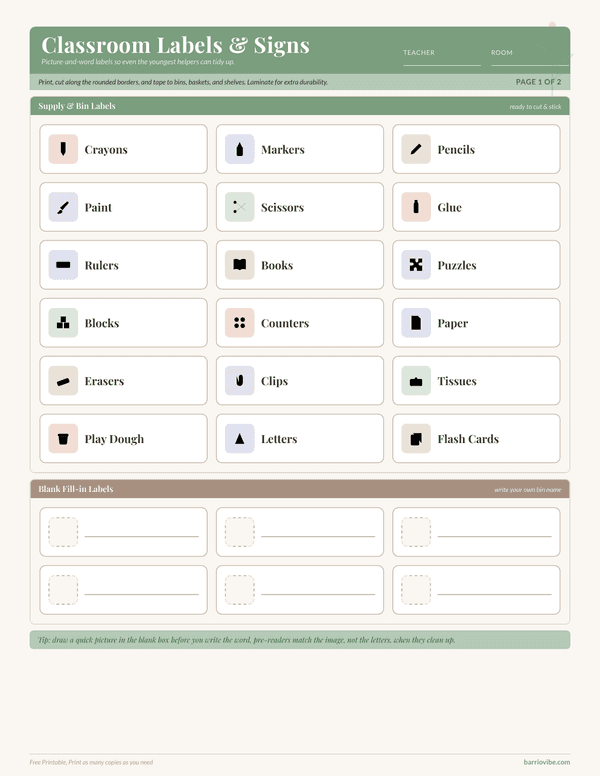
Classroom Labels & Signs, Free Printable
A set of printable classroom labels with matching picture-and-word supply bin tags, learning-center signs, and rotating job chart tags. Just print, cut, and stick to set up a calm, self-running room in minutes.
How do you match your classroom rules to your classroom theme?
Match your rules to your theme by locking three design choices, one font pairing, one color palette, and one border style, and applying them to every sign in the room. Consistency, not decoration, is what makes a space feel intentional. Pick a single display font for headers and one clean font for body text, choose two or three theme colors, and repeat that same frame around your rules poster, your labels, and your signs so they read as one set instead of a collage. A cohesive classroom rules printable should share the exact look of your bin tags and job chart, which is why a matched label-and-sign set beats piecing together random downloads. If you are still choosing a direction, our guide to classroom decor on a budget walks through building a whole coordinated look without overspending. The theme is just the wrapper; keeping it uniform is what makes your rules feel official rather than decorative.
Where should you post your classroom rules and signs?
Post your main rules where every student can see them from their seat, usually near the board or at the front, and place smaller signs exactly where the behavior happens. One central rules poster anchors the class, but signs do their real work at the point of use: a "quiet voices" card by the reading corner, a line-up reminder by the door, a "push in your chair" tag at the tables. This spreads your expectations around the room so students get the cue at the moment they need it, not just during morning meeting. Hang the master rules at kid eye level, not adult eye level, and keep the area around it uncluttered so it stays readable. Signs also carry your theme into every zone, which ties the room together visually. If you are planning a coordinated display wall, these back-to-school bulletin board ideas show how to frame your rules as the centerpiece rather than an afterthought.
What is the best way to teach classroom rules in the first week?
Teach the rules the same way you teach any lesson: introduce them, model them, practice them, and review them daily for the first two weeks. Do not just read the poster aloud on day one and assume it stuck. Spend the opening days walking through each rule, showing exactly what "be ready" or "be safe" looks and sounds like, then having students role-play the right version and the wrong version so the line is unmistakable. Reference the posted signs constantly, point to them when you praise, redirect, or reset, so the printable becomes a living tool, not wallpaper. Build in a quick daily review during the first two weeks, then taper as the routines become automatic. Involving students in defining examples early gives them ownership, which is the single biggest predictor of whether rules hold up by October. Consistency in those first days sets the tone for the entire year.
How do you keep your rules and signs reusable year after year?
Print on cardstock and laminate everything you plan to reuse, and store each set flat in a labeled folder so it is ready next August. The upfront work of building a coordinated rules-and-signs set pays off only if the pieces survive a full year of little hands and a summer in a closet. Run your posters and labels through a laminator, or slip them into self-sealing laminating pouches, which hold up far better than a bare sheet and let you write on cards with a dry-erase marker for flexible groups or seating. Punch holes and use rings for sign sets you rotate, and keep a master digital copy so you can reprint a single damaged card instead of the whole batch. A reusable classroom rules printable turns a one-time setup into a system you tweak, not rebuild, every year. Store by theme, and your future self starts the year calm instead of scrambling.
Classroom Labels & Signs, Free Printable
A set of printable classroom labels with matching picture-and-word supply bin tags, learning-center signs, and rotating job chart tags. Just print, cut, and stick to set up a calm, self-running room in minutes.
Get the words right, wrap them in one consistent look, and put them where the behavior happens, that is the whole formula. Print the set, laminate what you'll reuse, and walk into day one with a room that already knows the rules.
Frequently Asked Questions
How many classroom rules should you have?
Aim for three to five. Fewer than three feels arbitrary, and more than five is too many for students to remember and follow. A short set of broad, positive rules like Be kind, Be safe, and Be ready covers almost any specific behavior without turning into a long list of prohibitions.
Should classroom rules be positive or negative?
Positive. Phrase every rule as what to do rather than what to stop, Be respectful instead of Don't interrupt. Positive rules set a clear expectation, change the tone of the room, and give students a concrete action to aim for instead of just a behavior to avoid.
Should students help make the classroom rules?
Yes. Letting students brainstorm examples of what each rule looks like builds ownership, which is the biggest predictor of whether rules hold up past the first month. Keep the core rules broad and teacher-set, then invite the class to define what Be ready or Be safe means in practice.
Where should you post classroom rules?
Post the main rules poster at kid eye level near the board where everyone can see it from their seat, and place smaller signs exactly where the behavior happens, a quiet-voices card by the reading corner or a line-up reminder by the door. Point to them often so they stay a living tool.
How do you make classroom signs reusable year after year?
Print on cardstock and laminate everything you plan to reuse, then store each set flat in a labeled folder by theme. Laminating pouches let you write with a dry-erase marker for flexible groups, and keeping a master digital copy means you can reprint one damaged card instead of the whole set.