Some links in this guide are affiliate links, if you buy through them we may earn a small commission at no extra cost to you. Here’s our disclosure.
Quick Answer
The best back-to-school bulletin board ideas are quick to build and easy to reuse: choose a warm headline, add one repeatable student piece like a name tag, and frame it in a single accent color. Print headers and labels from one coordinated set, then swap only the center each season.
The bulletin board is the first thing anyone sees when they walk into your room, and right now it is a bare rectangle of cork with a few leftover staples from June. You have scrolled Pinterest until every idea blurs together, priced out a themed kit that costs more than your weekend, and cut out exactly one paper apple before deciding to deal with it later. Later is now the night before Meet the Teacher. The pressure is real: a good board is supposed to feel welcoming, organized, and clever all at once, and somehow yours has to do all that while also surviving until winter break. If you have ever stood in front of a blank board at 7 a.m. with a cold coffee and a staple gun, wondering how other teachers make theirs look so effortless, you are not out of ideas, you are out of a plan.
What are the best back-to-school bulletin board ideas?
The best back-to-school bulletin board ideas share one thing: they are quick to build, easy to reuse, and welcoming to kids on the very first day. Start with a warm headline like "Welcome to Our Class," add one repeatable element, a name tag, a star, a leaf, or a photo, for every student, and frame it all in a single accent color. Directions that never miss include a "Meet Our Class" board with student names, a "Goals for the Year" board where kids pin a written hope, a countdown or calendar board, and a "Class Rules" board that doubles as quiet management. Each of these is built from printable pieces you can make in minutes: headers, name tags, and labels from one coordinated set. If you want a low-effort win, an interactive board, a "First-Day Feelings" chart kids move a clip on, or a birthday board they help fill in, earns its space by doing a job all year, not just looking nice in August. The trick is picking a single idea and executing it cleanly instead of cramming three themes onto one board. A calm, single-theme board reads as intentional, even on a tight budget.
What should actually go on a back-to-school bulletin board?
Every strong board has four building blocks: a headline, a repeatable student element, a functional feature, and a border that ties it together. The headline announces the theme in a few big letters. The repeatable element, one name tag, apple, star, or bookmark per child, makes the room feel like it belongs to the students, not the catalog. The functional feature earns its wall space: a schedule, a job chart, a word wall, or a rules poster you would need anyway. The border frames everything in your accent color and hides the ragged edge of the cork. Here is a quick map of what to print for the most popular boards:
| Board theme | Headline | Repeatable piece | Functional add-on |
|---|---|---|---|
| Welcome / Meet the Class | "Welcome to Room 12" | Student name tags | Class photo or seating map |
| Goals & Dreams | "Our Goals This Year" | Fill-in goal cards | Reflection each grading period |
| Classroom Jobs | "Our Classroom Helpers" | Job title cards | Rotating name clips |
| Reading Nook | "Look What We're Reading" | Book-spine cutouts | Genre labels |
Pull all four pieces from one coordinated printable set so the fonts and colors match, and the board looks designed instead of assembled.
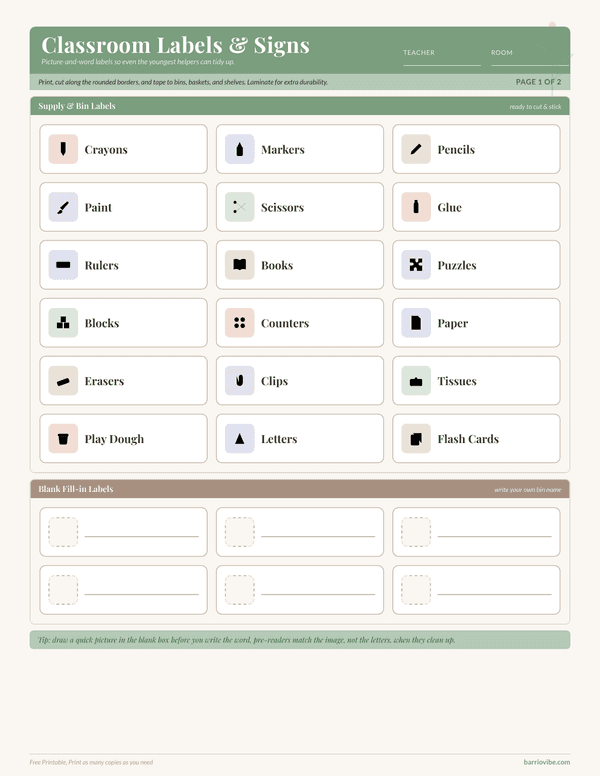
Classroom Labels & Signs, Free Printable
A set of printable classroom labels with matching picture-and-word supply bin tags, learning-center signs, and rotating job chart tags. Just print, cut, and stick to set up a calm, self-running room in minutes.
How do you make a bulletin board on a budget?
You can build a beautiful board for a few dollars by printing your own pieces and reusing the backing and border year after year. Skip the pre-made theme kits, they run forty to sixty dollars for one look you will retire in June, and print headers, name tags, and labels on plain cardstock from a single coordinated set. Back the board with inexpensive butcher paper or fabric in your accent color, then frame it with a simple border you staple once and leave up. The one upgrade genuinely worth it is a basic home laminator: it turns paper cutouts into reusable, spill-proof pieces you can pull out again next August instead of recutting them from scratch. Reuse is where the real savings live, staple the backing and border once, then swap only the printable middle each season. Watch for free background materials too: a roll of leftover kraft paper, fabric from a thrifted sheet, or even a painted section of wall behind the cork all read as intentional and cost almost nothing. A fifteen-dollar board rebuilt four times easily beats a sixty-dollar themed kit used once and recycled by winter.
What size and layout make a bulletin board easy to read?
A bulletin board reads best when it follows a clear visual hierarchy: one large headline across the top, a single organized zone of repeated pieces below, and enough empty space that nothing feels crowded. Work from a grid, line your name tags or student pieces up in even rows and columns rather than scattering them, because the eye reads order as "designed." Keep the headline letters large enough to read from the doorway, roughly four to six inches tall, and align them consistently to the left or center. Leave a margin of background color around the whole arrangement so the border has room to breathe. If your board is wide, split it into two or three clear sections instead of one busy field. Color helps too: limit yourself to your two theme colors plus one accent, and let the accent appear only in the border and headline. Overlapping a few pieces slightly and adding one simple layered border, a scalloped edge over a straight one, adds depth without adding clutter. Restraint is what separates a calm, professional board from a cluttered one, and it is the single fastest way to make free printables look like a designed collection.
How do you keep a bulletin board fresh all year?
Design the frame once and swap only the center, and a single board will carry you from August all the way to June. Staple a neutral backing and a reusable border, then treat the middle as interchangeable: a welcome theme in fall, student work in winter, a goals refresh in the new year, and a celebration board in spring. Keep your printable files in a labeled folder, digital and physical, so reprinting a fresh set for the next season takes two minutes, not a whole planning period. A rough seasonal rotation keeps the wall relevant without a full rebuild:
- Late summer: Welcome and "Meet the Class"
- Fall: Goals, routines, and a job chart
- Winter: Student work showcase or word wall
- Spring: Achievements, countdowns, and end-of-year memories
The best seasonal bulletin board ideas plan for this from the start: choose a first board whose headline and border still work in December, so you are only ever changing the middle. Because the border and backing stay put, each "new" board is really just a printable swap, the same few dollars of paper, reused into a wall that looks refreshed every season. That is the difference between a board you dread rebuilding and one that quietly updates itself.
How do you match your bulletin board to the rest of your classroom?
Anchor your board to the same palette and font as your labels and signs, and it stops competing with the room and starts anchoring it. Pull the headline, name tags, and any labels from the same coordinated printable set you used for your bins and shelves, so every surface speaks one visual language. Repeat your single accent color in the border and one small motif, a star, a leaf, a shape, that already appears elsewhere in the room. A board that echoes your decor makes the whole wall feel curated; a board in random clip-art colors fights everything around it. If you are still choosing an overall look, our guide to classroom decor on a budget walks through picking one palette and applying it everywhere for a few dollars. And to keep your signage on-theme, this set of classroom rules and theme signs drops straight into the same colors. Coordinate once, and the board practically designs itself.
Classroom Labels & Signs, Free Printable
A set of printable classroom labels with matching picture-and-word supply bin tags, learning-center signs, and rotating job chart tags. Just print, cut, and stick to set up a calm, self-running room in minutes.
Pick one theme, pull your pieces from a single coordinated set, and build the frame so you can reuse it. A welcoming, pulled-together bulletin board is made one printable at a time, not one expensive kit at a time.
Frequently Asked Questions
What are good back-to-school bulletin board ideas?
Try a "Meet Our Class" board with student name tags, a "Goals for the Year" board where kids pin a written hope, a classroom jobs board, or a reading board. Each uses printable headers, name tags, and labels from one coordinated set and takes only minutes to assemble.
How do you make a bulletin board on a budget?
Print your own headers, name tags, and labels on cardstock instead of buying $40-60 theme kits. Back the board with cheap butcher paper or fabric, staple a reusable border once, and swap only the printable center each season so one board lasts the whole year.
What should you put on a first-day-of-school bulletin board?
Include four things: a welcome headline, a repeatable student element like a name tag or star, a functional feature such as a schedule or job chart, and a border in your accent color. Pull every piece from one coordinated set so the fonts and colors match.
How big should bulletin board letters be?
Make headline letters roughly four to six inches tall so they read clearly from the classroom doorway. Align them consistently to the left or center, keep the wording short, and leave a margin of background color around the whole arrangement so the border has room to breathe.
How do you keep a bulletin board looking fresh all year?
Design the frame once and change only the middle. Staple a neutral backing and reusable border, then rotate the center by season: welcome in fall, student work in winter, goals in the new year, and celebrations in spring. Keep your print files so refreshes take two minutes.