Some links in this guide are affiliate links, if you buy through them we may earn a small commission at no extra cost to you. Here’s our disclosure.
Quick Answer
The best small kitchen organization ideas build upward and inward: clear the counters, add shelf risers to double cabinet height, use walls and cabinet doors for utensils and lids, and group items into labeled zones. Print a set of pantry and kitchen labels so every item has a visible, easy-to-return home.
You open the same cabinet three times looking for the measuring cups, shove the blender aside to reach the pasta, and still end up stacking clean bowls on the counter because there is nowhere else for them to go. In a small kitchen, every square inch is already spoken for, so one new gadget or a single grocery haul tips the whole room into chaos. It is not that you own too much, exactly, it is that nothing has a home small enough to fit. The counters double as storage, the cabinets are packed two rows deep, and the pantry is a single skinny cupboard where things go to be forgotten. You reach for the olive oil and knock over three other bottles; you buy pasta you already had because you could not see the box behind the cereal. You have probably tried "just decluttering," only to watch the mess creep back within a week, because the stuff had nowhere permanent to land. The real issue is not effort or willpower. It is that a tight kitchen needs a system built for its size, not a bigger kitchen's rules crammed into a smaller footprint.
What are the best small kitchen organization ideas?
The best kitchen organization ideas small spaces respond to are the ones that build upward and inward instead of spreading out. Start by clearing counters completely, then earn each item back only if you use it weekly, everything else moves into storage or out of the kitchen. Next, add a second shelf inside tall cabinets with stackable risers to double your vertical space. Hang a rail or magnetic strip for utensils and knives to free up drawers. Use the inside of cabinet doors for measuring spoons, foil, and pot lids. Finally, group items into zones, baking, coffee, cooking, so related things live together and you stop crisscrossing the room. The guiding principle for any small kitchen is that flat surfaces are for working, not for storing. Tackle it one zone at a time rather than pulling the whole kitchen apart at once, so you never lose your nerve halfway through. When the counters stay clear and every category has a defined home, even a tiny kitchen feels calm, open, and genuinely usable, and it stays that way because putting things back is finally obvious.
How do you organize a small kitchen with no counter space?
When counter space is the bottleneck, the fix is to move storage off the counter and onto the walls, doors, and the space above your head. A wall-mounted rail with S-hooks holds mugs, utensils, and even small pots, reclaiming an entire counter's worth of surface. A magnetic knife strip frees the block that eats a corner. Over-the-sink cutting boards and roll-up drying racks turn the sink into temporary prep space, then disappear. Mount a slim shelf above the backsplash for oils and spices you reach for constantly. Inside cabinet doors, adhesive holders keep sponges and wraps within reach but out of sight. The one rule that changes everything: nothing lives on the counter unless you use it every single day. A coffee maker earns its spot; the stand mixer you use monthly does not. A narrow rolling cart tucked beside the fridge adds a mobile shelf you can wheel to wherever you are prepping, then park out of the way. Clear counters do not just look better, they give you room to actually cook.
How should you organize cabinets and drawers in a small kitchen?
Organize small-kitchen cabinets by zone and by height so every inch works and nothing hides behind something else. Assign each cabinet a job, one for everyday dishes near the dishwasher, one for baking near the oven, one for food storage, so you stop hunting. Add stacking shelf risers to split a tall cabinet into two usable levels, and use a lazy Susan in the corner cabinet that would otherwise swallow items whole. In drawers, insert adjustable dividers to keep utensils from tangling, and store lids upright in a rack instead of nesting them. The single biggest upgrade, though, is labeling: clear bins and labeled containers mean anyone in the house can find and return things without a treasure hunt. A cabinet zone map and a set of ready-made labels turn a chaotic cupboard into a system that actually holds. That is exactly what this free printable is built to do.
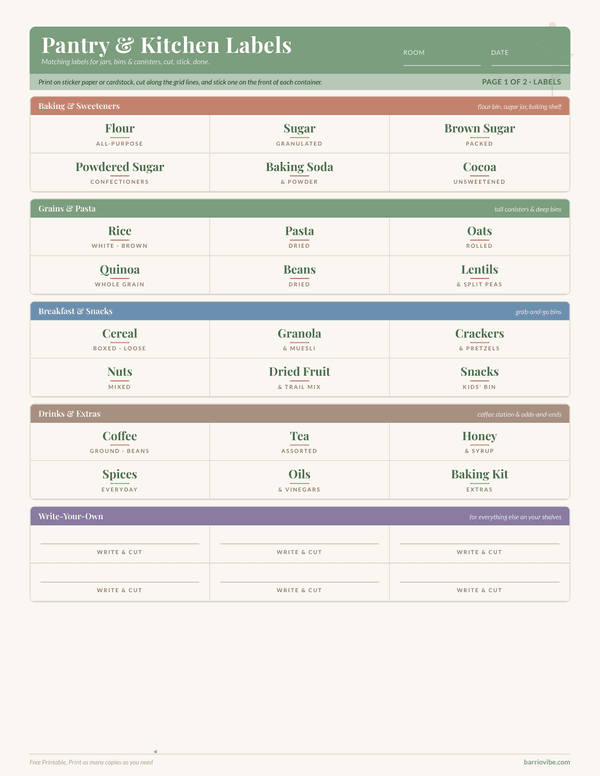
Pantry & Kitchen Labels, Free Printable
A free printable set of pantry and kitchen labels for jars, bins, and canisters, plus a cabinet zone map to plan where everything goes. Print on sticker paper or cardstock, cut, and stick.
How do you make a tiny pantry work in a small kitchen?
A tiny pantry works when you decant, contain, and label, three moves that turn a crammed shelf into a clear inventory. Start by transferring bulky boxes and bags into uniform, stackable containers; they fit together tightly and reclaim the wasted air that packaging creates. Then group like with like and give each group a labeled bin so you can pull the whole category out at once:
- Breakfast: cereal, oats, granola bars in a pull-out bin
- Baking: flour, sugar, and chocolate chips decanted into matching jars
- Snacks: a single low bin the kids can reach without climbing
- Cans and jars: on a stepped riser so back rows stay visible
Reserve the door for spice racks or slim over-the-door shelving. The organizing principle for a small pantry is see it or lose it: anything you cannot see, you will re-buy and let go stale. Once every category has a labeled home, restocking becomes obvious and your grocery list writes itself from a two-second glance at the shelf.
What are the best storage solutions for a small kitchen?
The best small-kitchen storage solutions are the ones that use dead space, vertical gaps, cabinet doors, toe-kicks, and the walls, without adding visual clutter. A short, prioritized list of what earns its place in a tight kitchen:
| Storage solution | Reclaims | Best for |
|---|---|---|
| Stackable shelf risers | Vertical cabinet air | Dishes, cans, mugs |
| Clear stackable bins | Deep-shelf chaos | Pantry categories, snacks |
| Tension rod under sink | Awkward cabinet height | Spray bottles, gloves |
| Over-door racks | Unused door backs | Foil, lids, spices |
| Drawer dividers | Tangled drawer space | Utensils, tools |
| Magnetic wall strip | Counter footprint | Knives, metal tins |
When you invest in containers, a set of clear stackable bins pays off more than anything else, you can see contents at a glance, they stack without wobbling, and swapping in ready-made labels makes the whole system readable in seconds. Buy one size and buy multiples; matching containers tessellate, while mismatched ones waste the very space you are trying to save. Measure your shelves first so bins fit front to back, and choose a depth you can pull all the way out, storage you have to dig into is storage you will stop using. Prioritize the two or three spots that frustrate you most instead of buying for the whole kitchen at once.
How do you keep a small kitchen organized long-term?
You keep a small kitchen organized long-term by protecting the system with tiny, repeatable habits rather than occasional big overhauls. Do a 60-second reset each night, clear the counters, return strays to their labeled home, and wipe surfaces, so clutter never gets a foothold. Follow a one-in, one-out rule: a new mug means an old one leaves, which keeps a tight kitchen from silently overfilling. Once a season, pull everything from one zone, wipe it down, toss expired food, and re-label anything that has drifted. The labels are what make it stick, because they hold everyone in the house to the same map. If your cabinets are the weak spot, our kitchen cabinet organization printable breaks each cupboard into a clear plan, and if you are working with a rental galley, these apartment kitchen organization ideas are built for the smallest footprints. Print the labels, set the zones, and let the system carry the load.
Pantry & Kitchen Labels, Free Printable
A free printable set of pantry and kitchen labels for jars, bins, and canisters, plus a cabinet zone map to plan where everything goes. Print on sticker paper or cardstock, cut, and stick.
Small kitchens do not need more space, they need a smarter map. The best kitchen organization ideas small spaces respond to all share one thread: give every item a visible, labeled home and defend it with a quick daily reset. Clear the counters, claim the vertical inches, label every zone, and protect it with a 60-second nightly tidy. Print the labels, stick them on, and let your tiny kitchen finally run itself.
Frequently Asked Questions
How do I organize a very small kitchen with limited cabinets?
Move storage off the counters and onto the walls, cabinet doors, and vertical cabinet space. Add shelf risers to double each cabinet's height, hang a rail for utensils, use the inside of doors for lids and wraps, and group everything into labeled zones so items are easy to find and return.
What is the best way to organize kitchen cabinets in a small space?
Assign each cabinet one job by zone: everyday dishes near the dishwasher, baking near the oven, food storage together. Use stacking risers to split tall cabinets, a lazy Susan in corners, drawer dividers for utensils, and clear labeled bins so anyone can find and return items without hunting.
How do I create counter space in a tiny kitchen?
Keep only what you use daily on the counter and relocate everything else. Add a wall rail with hooks, a magnetic knife strip, an over-the-sink cutting board, and a slim shelf above the backsplash. A narrow rolling cart also adds mobile prep space you can park out of the way.
How do I organize a small pantry?
Decant boxes and bags into uniform stackable containers, group like items into labeled bins, and use stepped risers so cans in the back stay visible. Reserve the door for spice or over-the-door racks. Anything you cannot see, you will re-buy and let go stale, so keep everything visible.
What storage containers work best for a small kitchen?
Clear stackable bins are the highest-value buy: you see contents at a glance, they stack without wobbling, and labels make the system readable in seconds. Buy one size in multiples so containers tessellate, and measure your shelves first so bins fit front to back and pull out fully.