Some links in this guide are affiliate links, if you buy through them we may earn a small commission at no extra cost to you. Here’s our disclosure.
Quick Answer
A pantry staples list is a written master inventory of the shelf-stable ingredients your kitchen always needs, sorted into seven groups: cooking basics, baking essentials, grains and pasta, canned goods, spices, condiments, and snacks. Keep one backup of each fast-mover, scan it weekly, and restock anything down to its last unit.
You reach for the flour to make pancakes on a slow Sunday morning and the bag is nearly empty. The recipe calls for a can of diced tomatoes and you have three of tomato paste instead. You bought olive oil last week, or did you? Half your grocery trips end with a duplicate you didn't need and a gap you didn't notice until you were mid-recipe, spatula in hand. When your pantry has no baseline, every meal starts with a hunt, every list gets guessed at in the car, and "quick dinner" turns into a second trip to the store just as everyone's getting hungry. It isn't that you're disorganized or forgetful. It's that a working pantry runs on a known set of ingredients, and nobody ever wrote yours down. Without that reference, you're rebuilding your kitchen from memory every single week, and memory is exactly the wrong tool for a shelf you can't fully see into. The good news is that this is a fixable problem, and it starts with one page.
What exactly belongs on a pantry staples list?
A pantry staples list is a written master inventory of the shelf-stable ingredients your household uses often enough that you should never run out of them. It usually covers seven groups: cooking basics (oil, vinegar, broth), baking essentials (flour, sugar, baking soda), grains and pasta, canned goods (beans, tomatoes, tuna), spices and seasonings, condiments and sauces, and shelf-stable snacks. The point isn't to stock everything, it's to stock your things, the ingredients that show up in the meals you actually cook week after week. A good list is personal: a household that bakes on weekends needs more flour and yeast, while a busy family leans on canned beans, broth, and pasta for fast weeknight dinners. Write down what you reach for repeatedly, and you turn a vague "we need groceries" into a precise, checkable reference you can hand to anyone in the house. That single document ends the guessing, the accidental duplicates, and the mid-recipe surprises for good.
How should you organize your pantry staples by category?
Group your staples by category, not by aisle, because a categorized list mirrors how you actually cook and makes gaps obvious at a glance. When everything is sorted into clear sections, you can scan one group, say, canned goods, and instantly see you're out of black beans without reading the whole page. Here's a starter framework you can adapt to your own kitchen:
| Category | Core staples to always keep |
|---|---|
| Cooking basics | Olive oil, neutral oil, vinegar, broth or stock, soy sauce |
| Baking essentials | All-purpose flour, sugar, brown sugar, baking soda, baking powder, vanilla |
| Grains & pasta | Rice, pasta, oats, quinoa, breadcrumbs |
| Canned goods | Diced tomatoes, tomato paste, beans, tuna, coconut milk |
| Spices & seasonings | Salt, pepper, garlic powder, paprika, cinnamon, chili flakes |
| Condiments & sauces | Ketchup, mustard, mayo, hot sauce, honey, peanut butter |
| Shelf-stable snacks | Crackers, nuts, dried fruit, granola bars, popcorn |
Adjust the rows to match your cooking. A category-based list is the backbone of a pantry that restocks itself.
Rather than build these seven categories from a blank page, start from a ready-made template and cross out what your family doesn't use, it's far faster than remembering every staple cold. This free printable lays out all seven groups with a restock column already built in, so you can fill it once and reuse it every week:
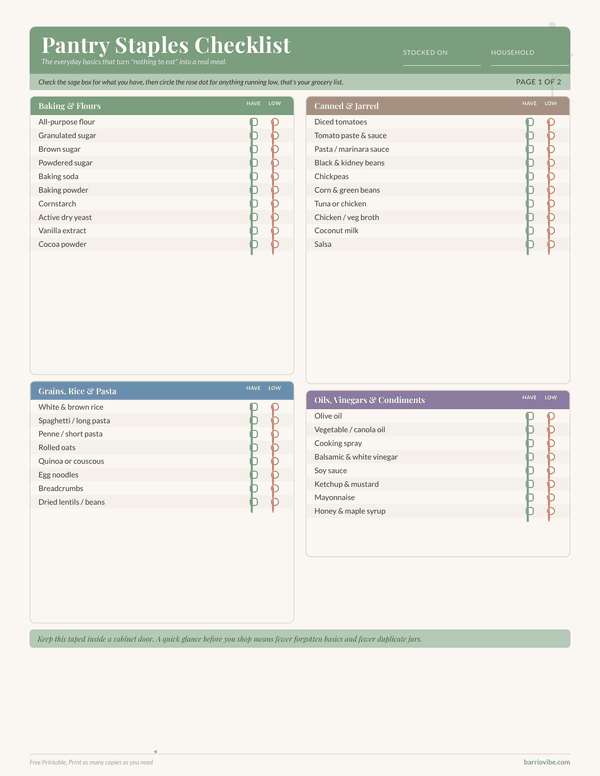
Pantry Staples Checklist, Free Printable
A printable pantry staples list that organizes every kitchen essential by category, with a check-the-box and running-low column so you always know exactly what to restock before you shop.
How much of each pantry staple should you keep on hand?
Keep enough of each staple to cover about two weeks of normal cooking, plus one backup of the items you'd hate to run out of mid-recipe. The right quantity depends on how fast you go through something, not on how much fits on the shelf. Fast-movers, olive oil, pasta, canned tomatoes, the flour you bake with, deserve a backup behind the open one, so opening the last package becomes your cue to restock, never your dinnertime emergency. Slow-movers like a specialty vinegar or a once-a-month spice only need a single jar; buying those in bulk just means they go stale or clump before you finish them. The goal is a simple "one in use, one in reserve" rhythm for the essentials and a "just one" rule for everything else. This keeps your pantry full enough to cook confidently but lean enough that nothing expires forgotten in back. Match each quantity to how quickly it turns over and your shelves stay useful, not crowded.
When should you restock your pantry staples?
Restock the moment you open your last backup of an item, not when the shelf is finally bare. If you wait until you're completely out, you've already hit the gap that sends you back to the store, so the trigger should be "down to one," not "down to none." The easiest way to catch this is a quick weekly scan: once a week, run your eyes down your pantry staples list and mark anything that's dropped to its last unit. Those marked items become next week's shopping list, caught early instead of discovered mid-recipe with the oven already preheating. Pair this rhythm with a set grocery day and restocking stops being reactive and starts being routine. This is also where a running list beats memory every time, you jot the item down the moment you notice it, so nothing depends on recalling it later in a crowded aisle. A dedicated restock column on your printable turns the whole thing into a ten-second weekly habit.
Pantry staples list vs. grocery list, what's the difference?
A pantry staples list is your permanent baseline; a grocery list is what you buy this week to return to it. The staples list rarely changes, it's the fixed set of ingredients your kitchen should always contain. The grocery list changes every trip, built from the gaps between that baseline and what's actually on your shelf, plus the fresh and perishable items for the meals you've planned. Think of it as a two-step system: the staples list tells you what a full pantry looks like, and the weekly scan tells you what's missing right now. Once you have both, building a shopping list stops being a from-scratch brainstorm and becomes simple subtraction. If you want a ready-made list to pair with your staples, our free grocery list template printable is organized by store section so you shop faster. And when you're deciding what to actually cook, a weekly meal planner turns your stocked pantry into an actual dinner plan.
How do you keep pantry staples organized and easy to see?
Store staples so you can see every item at a glance, because a pantry you can read is a pantry you can restock accurately. Start by grouping like with like, all the canned goods together, all the baking supplies on one shelf, so your physical pantry matches the categories on your list. Decant frequently used dry goods like flour, rice, and pasta into a set of clear airtight containers; you'll spot a low supply instantly and keep pests out, and a small label maker makes each one obvious and tidy. Put oldest items in front so nothing expires in the back. Keep your pantry staples list taped inside the door or slipped into a sheet protector, and do your weekly scan right there. The system only works if checking it is effortless, so make the list visible, the containers clear, and the restock note a ten-second reflex, not a chore.
Pantry Staples Checklist, Free Printable
A printable pantry staples list that organizes every kitchen essential by category, with a check-the-box and running-low column so you always know exactly what to restock before you shop.
Fill it in once this weekend, print your list, and tape it inside the pantry door where you'll see it every time you cook. From there the system runs itself: scan weekly, mark anything down to its last unit, and carry those items straight onto your shopping list. A kitchen that never runs out of the basics isn't built on a better memory or more willpower, it's built on one page you can actually see, doing the remembering for you.
Frequently Asked Questions
What are the most essential pantry staples?
The most essential pantry staples are cooking oils, vinegar, broth, flour, sugar, rice, pasta, canned beans and tomatoes, salt, pepper, and a few core spices. These cover the base of most everyday recipes, so keeping them stocked means you can always pull together a meal without a store run.
How do I organize a pantry staples list?
Organize your list by category rather than by store aisle: cooking basics, baking essentials, grains and pasta, canned goods, spices, condiments, and shelf-stable snacks. Categories mirror how you cook and make gaps obvious at a glance, so you can scan one group and instantly see what's running low.
How much of each pantry staple should I keep on hand?
Keep about two weeks of normal use, plus one backup of anything you'd hate to run out of mid-recipe. Follow a 'one in use, one in reserve' rule for fast-movers like oil and pasta, and a 'just one' rule for slow-movers so nothing expires in the back.
How often should I restock pantry staples?
Restock the moment you open your last backup of an item, not when the shelf is bare. A quick weekly scan of your list catches anything down to its last unit, and those items become next week's grocery list, so you never discover a gap mid-recipe.
Do I need to print a new pantry staples list every week?
No. Print one copy and slip it into a sheet protector to mark with a dry-erase marker during your weekly scan, or laminate it. Reprint only when you want a fresh copy, the list itself is a fixed baseline that rarely changes week to week.