
Some links in this guide are affiliate links, if you buy through them we may earn a small commission at no extra cost to you. Here’s our disclosure.
Quick Answer
A new year home reset checklist is a room-by-room plan to declutter, clean, and reset every zone of your home so it starts the year fresh. Pack holiday decor first, rehome gifts one-in-one-out, then reset each space over a focused weekend. Download the free printable and check off one zone at a time.
The tree is down, the ornaments are boxed, and somehow the house feels heavier than it did in December. Every surface has a layer of holiday leftovers, flattened gift boxes stacked by the door, a bowl of stray batteries and gift cards on the counter, a closet crammed with wrapping paper you swore you'd sort this time. The pantry is a graveyard of half-used baking supplies, the kids' new toys have nowhere to live, and the old ones they've outgrown are still underfoot. You keep hearing about the fresh-start feeling everyone promises in January, but standing in the middle of it, you genuinely don't know where to begin, and the sheer scale of it makes you want to shut the door and deal with it "later." If the new year has arrived and your home feels more cluttered than calm, you are not behind, and you are definitely not the only one staring at it.
What is a new year home reset checklist?
A new year home reset checklist is a room-by-room plan that walks you through clearing out, cleaning, and reorganizing your home so it starts the year fresh instead of buried under holiday leftovers. Unlike a one-day deep clean, a reset layers three moves into every space: declutter what no longer belongs, clean what the clutter was hiding, and reset the systems, bins, labels, and routines, that keep the space working. It's effective because it breaks an overwhelming whole-house project into small, ordered decisions you make one zone at a time, rather than confronting the entire home at once. A good checklist also front-loads the highest-impact areas, the ones you see and touch every single day, so you feel the payoff early and stay motivated to keep going. Think of it less as spring cleaning and more as a strategic reboot: you're not just making surfaces shine, you're deciding what actually earns a place in your home this year.
How do you reset your home after the holidays?
Deal with the holiday itself before anything else. Take down and pack decorations properly, grouped and labeled by room so next December is painless, then break down and recycle the gift packaging that's been multiplying by the door. Next, tackle the "gift influx": every new item needs a home, which usually means removing something older to make room, a natural one-in-one-out moment for toys, clothes, and kitchen gadgets. Then reset the spaces the holidays hit hardest, the kitchen after weeks of baking, the entryway drowning in coats and boots, and the guest room that quietly became storage. Finally, return to normal rhythms: restock everyday supplies, catch up the laundry, and put the family calendar back to a regular week. Doing it in this order genuinely matters. Clearing the holiday-specific clutter first stops you from carefully "organizing" things that should simply leave the house, so the deeper reset that follows moves faster and feels dramatically lighter with every zone you close out. One more post-holiday move worth building in: set out a donation box and a recycling bag before you start, so decisions have somewhere to go the second you make them. Nothing derails a reset faster than a "maybe" pile that migrates from room to room all afternoon and ends up back where it started by dinner.
What should be on your new year home reset checklist?
Your checklist should cover every zone of the home, grouped so you can work through one at a time instead of drifting between rooms. The most useful format gives each space its own short declutter-clean-reset list. Here's the room-by-room breakdown this free printable follows:
| Zone | Reset focus |
|---|---|
| Kitchen & pantry | Toss expired food, wipe shelves, reset zones |
| Entryway & closets | Store winter gear, donate outgrown coats |
| Bedrooms | Fresh linens, clear surfaces, edit under the bed |
| Bathrooms | Toss old products, restock, wipe cabinets |
| Living room | Rehome holiday gifts, dust, reset baskets |
| Home office & paper | Shred, file, set up this year's folders |
| Digital & calendar | Clear the inbox, plan meals, set January dates |
Working from the kitchen outward tends to feel best, because the room you use most sets the tone for the entire house. Check off each zone as you finish it, and resist chasing perfection, "reset" means functional and calm, not magazine-ready. The list exists to keep you moving so you never stall out wondering what comes next.
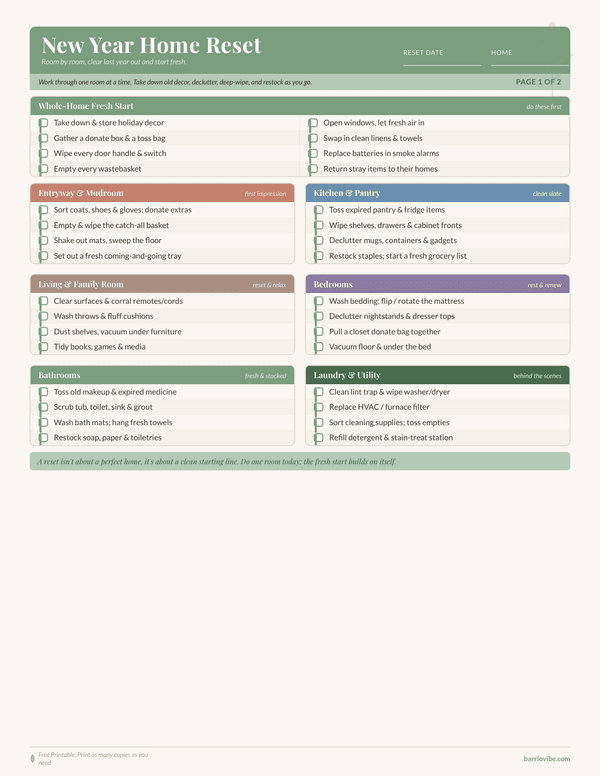
New Year Home Reset Checklist, Free Printable
A free printable New Year home reset checklist that walks you room by room through clearing out last year, plus a digital and paperwork reset section to start the year fresh.
How long does a new year home reset take?
Plan for a focused weekend, or spread it across the first week of January in one-zone-per-day pieces. A whole-home reset is bigger than a weekly tidy but smaller than a full spring clean, and most homes need roughly six to ten hours in total. Trying to power through it all in one marathon day usually backfires, decision fatigue sets in, and you end up cramming things into closets just to be finished. Instead, batch the work by energy. Do the physical, low-decision jobs, packing decorations, hauling recycling, vacuuming, when you're fresh, and save the mentally heavy sorting, paperwork, sentimental items, the kids' outgrown clothes, for a separate, quieter session. If a whole weekend isn't realistic, assign one zone per day and let the checklist carry over. A reset done over seven calm evenings beats one that never happens because you kept waiting for a magical free Saturday that never actually arrives. To keep any single session from running long, pair each zone with a hard stop, a lunch, a school pickup, or a timer, so you finish on a win instead of grinding until you resent the whole project. Progress, not perfection, is the entire point of this.
Where should you start if the whole house feels overwhelming?
Start with one visible, high-traffic surface, the kitchen counter, the dining table, or the entryway drop zone, never the hardest room in the house. Early visible wins build the momentum that carries you; resets stall out when people begin in the basement or a sentimental closet and burn out before lunch. Clear one flat surface completely, wipe it down, and commit to keeping it clear for the rest of the day. That single reset spot becomes living proof the whole house is possible, plus a landing pad you return to whenever your energy dips. From there, move to the room that stresses you most when you walk into it, for many people that's the kitchen, and let each finished zone fuel the next. Set a timer for twenty-five minutes per zone so no single space quietly swallows your whole day. And keep the checklist somewhere visible: crossing off zones is a small, real dopamine hit that pulls you through the parts you'd honestly rather avoid. If you stall halfway, don't restart from the top, just resume at the next unchecked zone. The reset is a guide, not a test you can fail, and a home that's eighty percent reset is a completely different place to live than the one you started the year in.
How do you keep your home reset all year?
Protect your reset with lightweight systems and a repeatable rhythm, or the clutter quietly creeps back by February. The three habits that hold a reset in place are a daily ten-minute tidy, a weekly reset day, and a seasonal mini-purge. Contain-and-label is what makes it actually stick: a set of clear stackable bins keeps like items together and visible, and a simple label maker turns "somewhere in that closet" into an obvious home the whole family can maintain without you. Buy storage last, though, only after you've decluttered, so you're organizing what you kept rather than buying room for what you should have released. To keep the momentum alive, pair your reset with an ongoing rhythm: our 30-day declutter challenge turns "someday" zones into ten-minute daily wins, while a steady weekly cleaning schedule keeps the whole house maintained so you never have to start another full reset from scratch again.
A fresh start was never about a flawless house, it's about a home that works for the year you're actually planning to live. Print the checklist, pick one zone, and let January be the month it finally comes together.
New Year Home Reset Checklist, Free Printable
A free printable New Year home reset checklist that walks you room by room through clearing out last year, plus a digital and paperwork reset section to start the year fresh.
Frequently Asked Questions
What is a new year home reset?
A new year home reset is a whole-home refresh that combines three moves in every space: decluttering what no longer belongs, cleaning what the clutter hid, and resetting systems like bins, labels, and routines. It's more strategic than a deep clean because it decides what earns a place in your home this year.
How do I reset my house after the holidays?
Start by packing decorations grouped and labeled by room, then recycle gift packaging. Rehome new gifts one-in-one-out, reset the spaces the holidays hit hardest like the kitchen and entryway, and return to normal rhythms by restocking supplies and catching up laundry. Clearing holiday clutter first makes the deeper reset faster.
How long does a new year home reset take?
Most homes need roughly six to ten hours total. You can do it in a focused weekend or spread it over the first week of January, one zone per day. Batch physical, low-decision tasks when you're fresh and save mentally heavy sorting like paperwork and sentimental items for a separate session.
Where should I start a home reset if I feel overwhelmed?
Start with one visible, high-traffic surface like the kitchen counter or entryway drop zone, not the hardest room. Clear it completely, wipe it down, and keep it clear all day. That early win builds momentum, then move to the room that stresses you most and let each finished zone fuel the next.
How do I keep my home organized after a reset?
Protect it with three habits: a daily ten-minute tidy, a weekly reset day, and a seasonal mini-purge. Use clear bins and labels so everything has an obvious home, but buy storage only after decluttering. Pairing your reset with a 30-day declutter challenge and a weekly cleaning schedule keeps clutter from creeping back.