Some links in this guide are affiliate links, if you buy through them we may earn a small commission at no extra cost to you. Here’s our disclosure.
Quick Answer
Geometric coloring pages are printable designs built from repeating shapes like hexagons, triangles, and mandalas, with clean edges you fill in with color. The best ones print sharp at full letter size with dark, even outlines, no watermark and no sign-up, so kids and adults can color the calming, structured patterns as many times as they like.
You sit down wanting something orderly to color, clean lines, repeating shapes, the satisfying symmetry that finally makes your shoulders drop, and instead you find pages that miss on both ends. Half of them are barely more than a few triangles floating on a mostly blank sheet, done in five minutes and forgotten. The other half are printed so densely the shapes collapse into a gray tangle you cannot even see to color inside. Maybe you love the precise, almost mathematical calm of a good pattern, or maybe a friend told you structured designs are the easiest way to quiet a busy mind, so you went looking for something better. Either way, you keep scrolling past pages that are too plain to hold you or too chaotic to enjoy. You are not asking for much: crisp shapes, a satisfying rhythm, and outlines dark enough to actually print. If that is the page you have been hunting for, you are in exactly the right place.
What are geometric coloring pages?
Geometric coloring pages are printable designs built from repeating shapes, triangles, hexagons, circles, and interlocking lines, arranged into symmetrical patterns, tessellations, and mandalas that you fill in with color. Unlike freeform illustrations, every section is bounded by a clean edge, so there is no guessing where one color stops and the next begins. That structure is exactly why people find them so satisfying: the page hands you a clear grid of small spaces, and your only job is to decide what goes where. Adult designs lean intricate, think honeycomb lattices, kaleidoscope bursts, or nested diamonds, while simpler versions use larger shapes that suit younger colorers or a quick, low-effort session. The best sheets print single-sided on standard letter paper with dark, even outlines so markers do not bleed through to the next design. In short, they trade whimsy for order, and that quiet order is the entire appeal.
Why are geometric patterns so relaxing to color?
Geometric patterns relax you because their repetition gives your brain a predictable rhythm to settle into, much like the steady focus of meditation. When a shape repeats across the page, you stop making decisions and start flowing: fill this hexagon, then the next, then the next, and the small, low-stakes motion quietly crowds out the anxious chatter that keeps you from unwinding. Researchers who study coloring have linked even brief sessions to measurable drops in anxiety, and structured designs amplify that effect because the clear boundaries remove any worry about straying outside the lines. Symmetry adds its own comfort. The human eye reads balanced patterns as orderly and safe, so a mirrored page feels calming before you have colored a single shape. There is no wrong answer and no deadline, which makes this one of the few tasks in your whole day that you genuinely cannot fail. That mix of rhythm, structure, and zero pressure is what makes it so deeply absorbing. It works for kids too, though for a slightly different reason: the bounded shapes build focus and pencil control while still feeling like play, so a busy child settles into the same quiet flow that an adult reaches after a long day.
Which geometric designs work best?
The best geometric designs are the ones whose repeating structure gives you a clear rhythm without crowding the page into a tangle. Honeycomb and hexagon patterns top the list, because their even cells are large enough to color comfortably yet numerous enough to keep you absorbed for a whole evening. Mandalas bring radial symmetry that pulls the eye inward, while tessellations reward you for repeating a color sequence across the sheet. Here are reliable favorites and why each one works so well:
| Design | Why it works |
|---|---|
| Honeycomb / hexagon | Even cells give a steady rhythm and room for gradients |
| Mandala | Radial symmetry draws the eye inward and feels meditative |
| Tessellation | Interlocking shapes reward a repeating color sequence |
| Kaleidoscope | Bursting symmetry suits bold, high-contrast palettes |
| Nested diamonds | Concentric layers are perfect for practicing ombre |
| Op-art grid | Warping lines create a striking three-dimensional effect |
Start with whichever pattern makes your shoulders drop just looking at it. If you are new to detailed work, a honeycomb or a simple tessellation eases you in gently before you take on a dense kaleidoscope or a warping op-art grid. Larger shapes are also the smart pick when you are coloring with kids or reaching for a quick session, while the fine, densely packed designs are the ones to save for a slow evening when you want something to sink into for an hour. The clean honeycomb design in the free page below is a perfect place to begin.
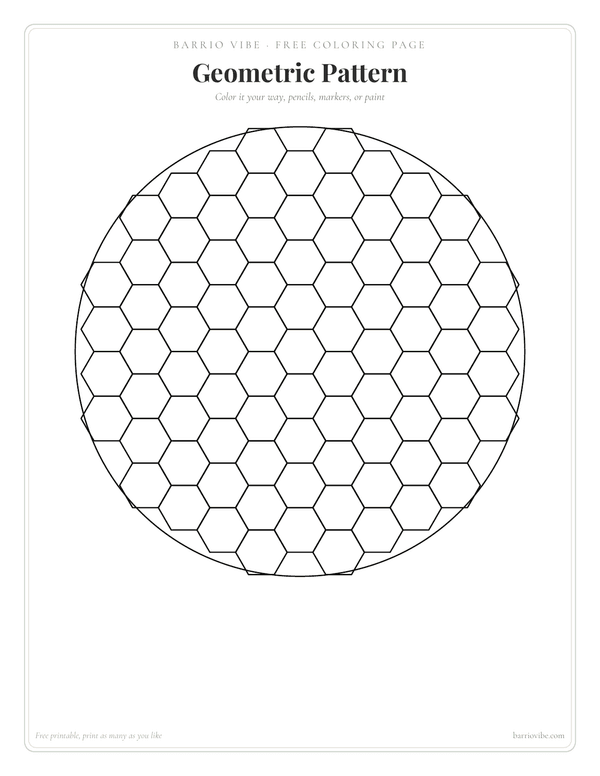
Geometric Pattern
An all-over tessellation of triangles and hexagons, a modern pattern to color.
What supplies work best for geometric coloring pages?
You need surprisingly little to start: printed pages, something to color with, and a hard flat surface. For crisp geometric coloring pages, fine-tip markers and gel pens are the standout choice, because their sharp points reach cleanly into corners and lay down bold, even color that makes hard-edged shapes pop. A quality set of fine-liner markers is the one upgrade genuinely worth making here, since cheap pens skip and streak, leaving patchy cells that undercut the whole clean-lined effect. Colored pencils still work beautifully if you prefer soft gradients within each shape, and a basic set of 24 colors covers most palettes. Keep the sheet on a hard surface so your lines stay steady, print on slightly heavier paper if your printer allows it so the ink does not bleed, and slip a spare sheet underneath to protect your table. Print directly from the PDF at full size for the darkest, sharpest outlines, and if the shapes look faint, switch your printer to its high-quality or darkest-black setting before you run the page. That, honestly, is the entire starter kit.
How do you choose colors that make a geometric page pop?
To make a geometric page pop, choose your color scheme before you start rather than filling shapes at random. Three approaches rarely fail. A monochrome scheme uses light-to-dark shades of a single color, which turns any pattern into an elegant ombre as the tone deepens across the page. A complementary scheme pairs opposites on the color wheel, blue with orange, purple with yellow, for high-contrast shapes that seem to vibrate. An analogous scheme uses neighbors, like teal, green, and lime, for a harmonious, restful feel. Repetition is your friend: pick three or four colors and let them recur in a fixed rotation so the eye follows the pattern around the sheet. For symmetrical mandalas, color mirrored sections the same shade to emphasize the balance. If you want a shortcut, pull three colors straight from a photo you love, a sunset, a tiled floor, a favorite mug, and you will land on a palette that already feels harmonious. There is no wrong palette, but a plan is what separates polished geometric coloring pages from a scattered grid, turning a busy design into something that looks deliberate and finished.
How do you make geometric coloring a relaxing habit?
Turn coloring into a habit by attaching it to a moment you already have, after dinner, during a show, or as a wind-down before bed, so you never have to decide when to begin. Keep a small kit and a few printed pages within arm's reach, because friction is what quietly kills a new habit; pencils buried in a drawer three rooms away guarantee you skip it. Set a low bar: ten unhurried minutes counts, and you never have to finish a page in one sitting. Structured designs are especially forgiving to pause and resume, because the pattern holds your place for you. Rotate your sheets so it stays fresh. Our free printable pattern coloring pages give you a whole menu of repeating designs to work through, and when you want something more intricate for a slow evening, these adult coloring pages reward patient, layered shading. Print a small stack, keep them where you will see them, and let the rhythm do the relaxing for you.
Pick one pattern, grab your pens, and give yourself full permission to color at your own unhurried pace. Start with the free geometric page below and let a busy evening finally slow down.
Geometric Pattern
An all-over tessellation of triangles and hexagons, a modern pattern to color.
Frequently Asked Questions
Where can I find free geometric coloring pages to print?
You can download free geometric coloring pages as clean PDF files and print them at home on standard letter paper. Look for high-resolution sheets with dark outlines, no watermark, and no forced email sign-up, so the shapes stay crisp and you can print as many copies as you need.
Are geometric coloring pages good for adults?
Yes. Intricate geometric designs like honeycombs, tessellations, and kaleidoscope mandalas are popular with adults for stress relief. The repeating shapes give the mind a steady, meditative rhythm, and the clean boundaries remove any worry about coloring outside the lines, which makes each page genuinely calming to fill in.
What supplies work best for geometric coloring?
Fine-tip markers and gel pens are ideal because their sharp points reach cleanly into corners and lay down bold, even color on hard-edged shapes. Colored pencils also work well for soft gradients inside each cell. A basic set of 24 colors covers most palettes you will want to try.
How do I choose colors for a geometric pattern?
Pick a scheme before you start. A monochrome palette shades one color light to dark for an ombre effect, complementary colors like blue and orange create high contrast, and analogous colors like teal and green feel restful. Repeat three or four colors in a fixed rotation so the eye follows the pattern.
How do I print coloring pages so the lines are dark and clear?
Print directly from the downloaded PDF, not a browser preview, and choose Actual Size or 100 percent scale instead of Fit to Page. If the outlines look gray, set your printer to its darkest black or high-quality mode. Printing several copies at once saves a mid-activity trip back to the printer.