Some links in this guide are affiliate links, if you buy through them we may earn a small commission at no extra cost to you. Here’s our disclosure.
Quick Answer
The best free printable math worksheets for early learners keep one skill per page, use large traceable numerals with plenty of white space, and finish in a few minutes. Match the page to your child's stage, practice a few minutes several times a week, and keep it playful to build number confidence.
Your four-year-old can rattle off the numbers to twenty in the bathtub, but hand them a page and ask them to circle the number seven and suddenly they freeze. Or they love counting the stairs but melt down the second a worksheet lands on the table, because it looks like "work." If you have ever printed a stack of math pages off the internet only to watch them go unused, too cramped, too many problems, too advanced, or just plain boring, the frustration is real. You are not trying to raise a math prodigy. You just want a few simple pages that meet your child where they are, hold their attention for more than ninety seconds, and make early numbers feel doable instead of discouraging. You want practice that fits into the ten spare minutes before dinner, not another activity that demands prep, patience, and a fight. The good news is that the pages themselves are usually the problem, not your child, and that is a much easier fix than it feels like right now, the right worksheet, at the right level, changes the whole mood at the table.
What makes a good free printable math worksheet for early learners?
The best free printable math worksheets for early learners keep one skill on each page, use large numerals with plenty of open space, and can be finished in just a few minutes. A young child's attention and pencil control are both still developing, so a page crammed with twenty tiny problems reads as overwhelming before they even pick up a crayon. Look for pages that isolate a single idea, tracing the number 3, counting five apples, matching quantities to numerals, rather than mixing counting, writing, and addition all at once. Big, traceable numbers with clear start dots help little hands succeed instead of scribbling. Generous white space signals "this is manageable." And a touch of visual interest, like objects to count or color, keeps the page from feeling like a test. Clear, kid-friendly directions help too, a single instruction your child can follow with minimal hand-holding builds independence and pride. When a worksheet matches a child's stage and finishes before their patience runs out, they actually want to do the next one.
What early math skills should worksheets cover by age?
Match the worksheet to your child's stage, not their birthday, but age gives a useful starting point. Early math builds in a predictable order: children recognize numbers before they write them, and count real objects before they add. Pushing addition on a three-year-old who still reverses their numerals only breeds frustration. Here is a rough guide to what printable math practice should focus on as skills develop:
| Age | Focus math skills | What the worksheet looks like |
|---|---|---|
| 2-3 | Counting aloud, "how many," shapes | Count-and-color pictures, big shape tracing |
| 3-4 | Number recognition, 1-to-1 counting | Circle the number, count objects to 5 |
| 4-5 | Writing numbers 0-10, comparing more/less | Number tracing lines, match quantity to numeral |
| 5-6 | Counting to 20, simple addition to 10 | Ten-frames, add-the-pictures, fill-in number lines |
The goal at every stage is confidence, not speed. When a page feels like the next small step rather than a leap, kids stay in the game, and that steady momentum matters far more than how early they start.
How do you use math worksheets without overwhelming a young child?
Offer one page at a time and stop while your child still wants more. For early learners, a single focused worksheet, or even half a page, is plenty for one sitting; ending on a high note keeps them eager to come back tomorrow. Sit beside them and treat it as something you do together, not a task you assign and walk away from. Read the directions aloud, point to the first problem, and let them lead from there. If they stall, model one out loud instead of correcting: "Let's count these together, one, two, three." Keep the tone light and skip the eraser wars; a wobbly number 5 today becomes a steady one in a month. Praise the effort, not just the right answer, "you counted every single one" tells a child that trying is the win. Most importantly, follow their energy. Ten happy minutes of number tracing builds more real math sense than a forced half-hour that ends in tears and a crumpled page.
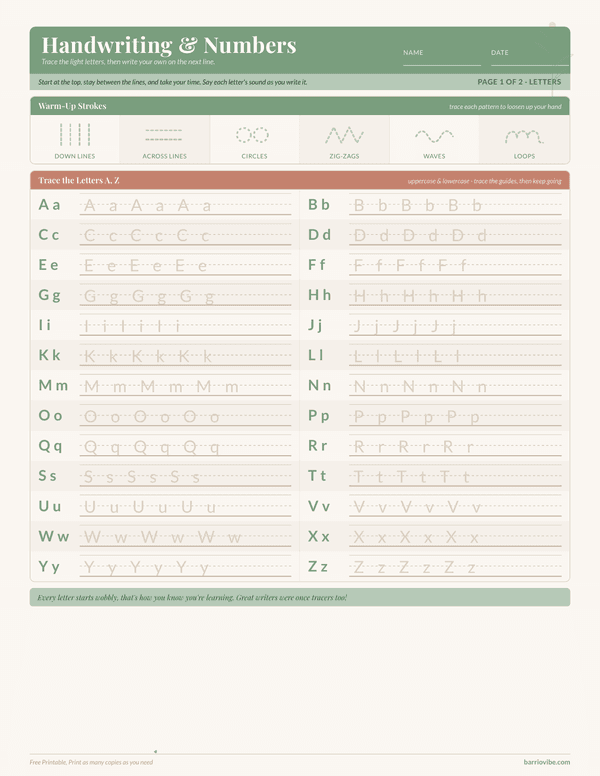
Preschool Handwriting & Numbers Worksheet, Free Printable
A free printable preschool handwriting worksheet with dotted guide lines for tracing uppercase and lowercase letters, numbers 1-10, and first words, plus warm-up strokes and count-and-write practice.
How much math practice does a preschooler actually need?
Just a few minutes, a few times a week, is genuinely enough for a preschooler. Early math is caught more than taught, so short, frequent bursts beat long marathon sessions every time, five to ten focused minutes with a single worksheet, two or three times a week, keeps skills growing without burning out either of you. Consistency matters far more than duration at this age. What fills in the rest is everyday life: counting grapes at snack, setting the table with the right number of forks, spotting numbers on mailboxes, sorting laundry by color. Worksheets are the practice reps that reinforce those real-world moments. A good rule of thumb: let your child's interest set the length, and stop the moment it fades rather than squeezing out a few more problems. If a page turns into a battle, put it away and try again another day, pushing past frustration teaches kids that math is something to dread, which is the opposite of what a few quiet minutes of number worksheets should do.
How do you make free printable math worksheets feel like play?
Turn the worksheet into a game, and reluctant learners lean in. Free printable math worksheets do not have to be silent, seated seatwork, the same page becomes play the moment you add a little imagination. Hand your child a favorite marker or a stamp instead of a pencil, and even number tracing feels like a treat. Roll a die and have them find that number on the page. Count with fingers, buttons, or toy cars laid right on top of the pictures. Use a small treasure-hunt voice: "Can you find the sneaky number 8?" A simple trick that saves paper and lowers the stakes is slipping pages into reusable dry-erase pouches so kids can wipe and redo them, the write-and-erase novelty alone earns you extra rounds, and one printed set lasts for months. You can even let your child "grade" your own deliberately silly mistakes, which quietly cements the skill they just practiced. When math practice feels like a game they chose, kids stop noticing they are learning and simply keep going.
Free printable math worksheets vs. workbooks and apps, which is best?
For early learners, free printables win on flexibility, workbooks on structure, and apps on engagement, and the strongest routine borrows from all three. Free printable math worksheets let you print exactly the skill your child needs today, reprint the ones that click, and skip the ones that do not, all at no cost and with nothing to store. Workbooks offer a tidy sequence but often march ahead whether or not a skill has landed, and half the pages go unused. Apps are wonderfully engaging, yet screen time has limits and swiping a tablet does not build the pencil control young hands need. The sweet spot for most families is a small stack of printables you pull from as skills develop, backed by real-life counting and the occasional app. For the letter-and-number side of the same routine, our free printable worksheets for kids pair letters with numbers, and if your child is heading into school our free printable kindergarten worksheets carry the same gentle approach into counting and early addition.
Preschool Handwriting & Numbers Worksheet, Free Printable
A free printable preschool handwriting worksheet with dotted guide lines for tracing uppercase and lowercase letters, numbers 1-10, and first words, plus warm-up strokes and count-and-write practice.
Keep a few pages ready, follow your child's lead, and let the numbers stay playful. Early math confidence is built a few cheerful minutes at a time, not in one perfect worksheet.
Frequently Asked Questions
At what age should kids start math worksheets?
Most children are ready for simple math worksheets around ages three to four, starting with counting objects and recognizing numbers. Match the page to the skill, not the birthday, a child who reverses numerals needs number tracing, not addition. Keep early pages short, playful, and pressure-free.
What math should a preschooler know before kindergarten?
Before kindergarten, most preschoolers can count to at least ten, recognize and name written numbers zero to ten, count small groups of objects one-to-one, compare more versus less, and identify basic shapes. Simple free printable math worksheets reinforce each of these skills a few minutes at a time.
How long should a preschooler spend on a math worksheet?
Just five to ten minutes, a few times a week, is plenty for a preschooler. Early math is caught more than taught, so short, frequent practice beats long sessions. Offer one page at a time and stop while your child still wants more, ending on a confident note.
Are free printable math worksheets as good as workbooks?
For early learners, free printables often work better than workbooks because you print exactly the skill your child needs today and skip the rest. Workbooks march ahead whether a skill has landed or not. A small stack of printables plus real-life counting gives you flexibility at no cost.
How do I make math worksheets fun for my child?
Turn the page into a game. Let your child use markers or stamps instead of a pencil, roll a die to find numbers, count with toys placed on the pictures, or slip pages into reusable dry-erase pouches so they can wipe and redo them. Playful practice keeps kids coming back.