Some links in this guide are affiliate links, if you buy through them we may earn a small commission at no extra cost to you. Here’s our disclosure.
Quick Answer
Floral coloring pages for adults are detailed flower and floral-mandala designs printed for a grown-up eye: intricate enough to hold your focus without straining it. They are a proven, screen-free way to de-stress. Print the free PDF at home, grab colored pencils, and fill one in for a calm 20-30 minutes.
You sit down to relax and your mind keeps running: the unanswered emails, the dishes, the text you forgot to send back. You have heard that coloring is supposed to help, so maybe you bought a book, opened an app, or printed the first page you found online. Then the page itself let you down. The lines were so tight and busy that filling them felt like more work, or the design was so plain it looked like something meant for a kindergarten wall. Neither one quieted anything. What you actually want is simple: a beautiful flower design, sized right for a grown-up attention span, that you can print at home tonight and lose yourself in for half an hour without buying anything or signing up for one more account. If that is the itch you have not been able to scratch, you are not being picky. You are just looking in the wrong places.
What makes a floral coloring page right for adults?
Floral coloring pages for adults work best when the design sits in a middle zone: detailed enough to hold your focus, but not so cramped that coloring feels tedious. The pages that frustrate grown-ups are usually one of two extremes, cartoon-simple flowers with three fat petals, or hyper-dense fields of tiny shapes that strain your eyes within minutes. The sweet spot is a botanically inspired bloom or a floral mandala with clear, flowing line work: defined petals, layered centers, and a few small filler areas for variety. It should give you real decisions to make (which shade for this petal, warm or cool for the leaves) without demanding a magnifying glass. Line weight matters too. Crisp, medium-weight outlines print cleanly on a home printer and give your color a clean edge to fill against. A little breathing room helps as well, so look for a design with open petals and a calm border rather than edge-to-edge detail, which keeps the page restful instead of relentless. When a design respects an adult eye and hand, coloring stops feeling like a chore and starts feeling like the break you actually wanted.
Are adult coloring pages actually good for stress relief?
Yes, coloring genuinely helps many adults down-shift, and the reason is mechanical, not mystical. Filling in a repetitive, low-stakes pattern occupies the same part of your attention that would otherwise loop over worries, a bit like the quiet focus that makes some people knit or garden to unwind. Because a flower design has no wrong answer and no deadline, your nervous system reads it as safe, and your breathing and shoulders tend to follow. Researchers who study art-making point to this kind of gentle, absorbing focus, often called a flow state, as a reliable way to lower felt stress in a single short sitting. You do not need talent or a finished masterpiece for the benefit, because the calm comes from the doing, not the result. It also asks almost nothing of you: no skill to learn, no app to open, and no way to fail, which is exactly why it works on the days you have the least energy. That is why so many people keep a stack of stress-relief coloring pages within reach. A five-minute page between meetings resets you far more than one more scroll through your phone.
What supplies do you need for floral coloring pages?
You need almost nothing to start: a printed page, something to color with, and a hard surface. That said, a few inexpensive choices make floral pages far more pleasant. A set of quality colored pencils is the most forgiving tool for flowers, because you can layer light to dark and blend petal gradients in a way markers cannot, and a decent 24-to-48-count set covers every bloom and leaf you will meet. Fine-tip markers or gel pens are lovely for small centers and crisp outlines, while a couple of blending stumps help soften pencil edges. Print on slightly heavier paper (28 lb works well) so colors stay vivid and markers do not bleed through to the table. Keep everything in one small pouch or tin so a session starts in seconds, not after a hunt for the sharpener. If you are just testing the waters, resist the urge to buy the giant 150-count set right away, since a modest range of colors is easier to choose from and less overwhelming when you only want to relax. The lower the friction to begin, the more often you will actually sit down and color.
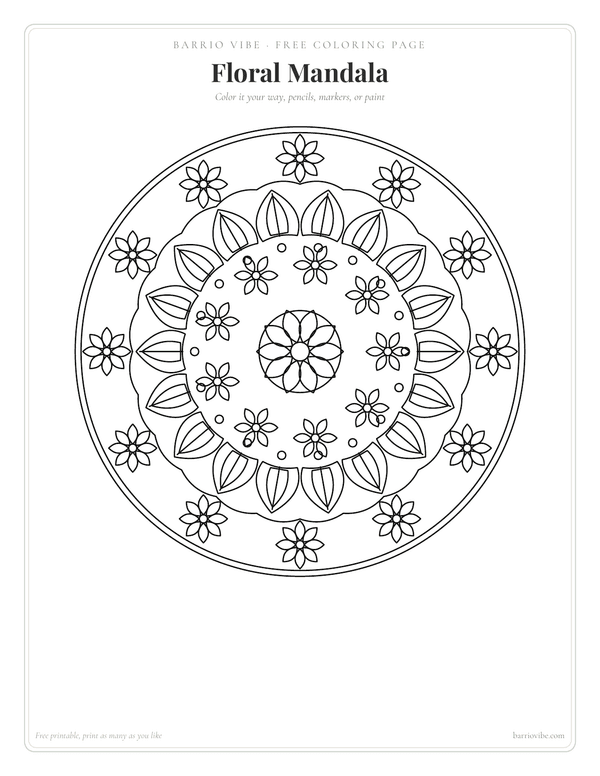
Floral Mandala
A symmetrical flower mandala with layered petals, a relaxing page to color in.
How do you shade flowers so they look realistic?
Shade from dark to light and from the center outward, and even a beginner's flower gains instant depth. Petals catch light at their edges and fall into shadow near the base, so the simplest rule is to keep your darkest color where the petals meet the flower's center and let it fade toward the tips. Here is a reliable order to follow:
- Base layer: color the whole petal in a light, even pass of your main color.
- Build shadow: add a second, darker layer only near the base and where petals overlap.
- Blend the seam: with a blending stump or a lighter pencil, soften the line between light and dark so it reads as a smooth gradient.
- Add a glow: touch a hint of a warmer or contrasting shade at the very center.
- Define edges: finish with a crisp outline so each petal stays distinct.
Work petals that do not touch at the same time so nothing smudges, and keep your leaves cooler and less saturated than the blooms so the flowers stay the star of the page. If realism feels like pressure, ignore all of it and color the flower purple with orange leaves, because the goal is a calm half-hour, not a botany exam.
Floral, mandala, or botanical: which style should you pick?
Pick the style that matches the mood you want, not the one that looks most impressive on screen. All three are floral at heart, but they ask different things of you. A single botanical bloom, like a rose or a peony, rewards patient, realistic shading and feels meditative and slow. A floral mandala arranges petals into a symmetric circle, so it scratches the itch for pattern and repetition and is easy to put down and pick back up. A loose bouquet or wreath gives you the most freedom to mix colors with no rules at all. Here is a quick guide:
| If you want | Reach for | Why it fits |
|---|---|---|
| Calm repetition | Floral mandala | Symmetry is soothing and forgiving |
| Realistic practice | Single bloom | Room to master shading and blending |
| Playful color mixing | Bouquet or wreath | Many small shapes, no rules |
A good rule of thumb: when you want to switch your brain off entirely, choose a mandala, and when you want to feel absorbed and a little challenged, choose a single detailed bloom. If realistic single blooms are your thing, our guide to flower coloring pages for adults goes deeper on petals and leaves. There is no wrong choice here, only the one that fits how you feel tonight.
How do you turn coloring into a calming habit that sticks?
Attach coloring to something you already do, and it stops being one more thing to remember. The people who color regularly rarely rely on willpower. They pair it with an existing anchor: the first coffee of the morning, the half-hour after the kids are down, or the wind-down before bed instead of a screen. Keep a printed page and your pencils out where you will see them, because a page already on the table gets colored and one buried in a drawer does not. Set a low bar too. A single flower, or even one petal, counts as a win. Some pages will get finished in one sitting and others will sit half-done for a week, and both are completely fine, because this is a break, not a project with a deadline. Print a few at once so you always have a fresh page waiting. When the ritual is easy to start and impossible to fail, it quietly becomes the calmest part of your day.
Floral Mandala
A symmetrical flower mandala with layered petals, a relaxing page to color in.
Print one, pour a drink you like, and let the flowers do the rest. Calm is only a few colored petals away.
Frequently Asked Questions
Are floral coloring pages good for adults?
Yes. Floral coloring pages made for adults use detailed, flowing line work that holds your focus without straining your eyes. The repetitive, low-stakes act of coloring occupies the mind the way knitting or gardening does, which helps many people lower stress in a single short, screen-free sitting.
What are the best supplies for coloring flowers?
Colored pencils are the most forgiving choice because they layer and blend for smooth petal gradients, and a 24-to-48-count set covers most designs. Fine-tip markers and gel pens are great for small centers, blending stumps soften edges, and heavier 28 lb paper keeps colors vivid without bleed-through.
How do you shade flower petals to look realistic?
Shade from dark to light, keeping the darkest color where petals meet the center and fading it toward the tips. Lay a light base layer first, add shadow near the base and overlaps, blend the seam with a stump, then finish with a crisp outline so each petal stays defined.
Do I need to print a new page every time?
No. You can slip one printed page into a sheet protector and color it with washable markers, then wipe and reuse it. Most people prefer printing fresh copies, though, since a blank flower page feels like a clean start and the PDF is free to reprint as often as you like.
Are these floral coloring pages really free to print?
Yes. The floral mandala coloring page is a free PDF with no sign-up or email required. Download it, print it on any home printer using standard letter-size paper, and make as many copies as you want for yourself, your family, or a relaxing evening with friends.