Some links in this guide are affiliate links, if you buy through them we may earn a small commission at no extra cost to you. Here’s our disclosure.
Quick Answer
The best preschool crafts for fall are simple, low-mess projects using materials you already have: leaf rubbings, paper-plate pumpkins, handprint turkeys, and apple stamping. Keep them to three or four big steps, use washable supplies, and let their version look nothing like the example, that's the point.
You've got a rainy afternoon, a restless three-year-old, and a Pinterest board full of crafts that need a hot glue gun, a forty-item supply list, and the patience of a saint. So you scroll, you save, and you close the app, because pulling any of it together feels like more work than just turning the TV back on. Fall is supposed to be the easy season for crafting: leaves on every sidewalk, pumpkins on every porch, cozy afternoons made for the kitchen table. But somehow the gap between "we should do a craft" and actually doing one keeps getting wider. The supplies are scattered across three different drawers, half the ideas are too advanced for little hands, and by the time you've finished setting up, someone needs a snack. If craft time keeps ending in frustration instead of a proud little smile, the problem isn't your kid, and it isn't you. It's that nobody handed you a plan.
What are the best preschool crafts for fall?
The best preschool crafts for fall are simple, low-mess projects built around materials you already have and shapes small hands can actually manage. Think leaf-rubbing art made with crayons and leaves gathered on a walk, paper-plate pumpkins painted orange, handprint turkeys, apple stamping with a halved apple and washable paint, and tissue-paper corn on the cob. The rule for this age is fewer steps, bigger pieces, and no fine-detail cutting. A good fall craft for a preschooler should take under twenty minutes to set up, use three or four materials at most, and leave plenty of room for their version to look nothing like the example, that's the whole point. Skip anything that calls for hot glue, tiny beads, or precise tracing, because those turn a fun afternoon into a battle. The magic of seasonal crafting isn't a gallery-worthy result; it's a child connecting the pumpkin they painted to the pumpkins they spot everywhere in October. If you're not sure where to begin, pick one craft that matches something your preschooler already loves, animals, stamping, or just getting messy with paint, and build from there. Start small and everything else gets easier.
What craft supplies do you actually need?
You need far less than the craft blogs suggest, a small, well-chosen supply stash covers almost every fall preschool craft. Instead of buying a fresh kit for each project, keep one core set on hand and you'll be able to say yes to craft time on the spot, no store run required. Here's the short list that carries the whole season:
| Category | What to stock | Covers |
|---|---|---|
| Paint | Washable red, orange, yellow, brown + foam brushes | Pumpkins, apple stamping, handprints |
| Paper | Construction paper + a roll of easel or butcher paper | Backgrounds, leaf rubbings, collages |
| Sticky + cutting | Washable glue stick, child-safe scissors | Assembling every project |
| Color | Crayons and washable markers | Rubbings, drawing, coffee-filter art |
| Nature bits | Leaves, acorns, pinecones | Rubbings, collage, sorting |
| Extras | Paper plates, cotton balls, tissue paper | Pumpkins, lambs, texture |
Buy the washable version of everything, it protects your table, their clothes, and your patience all at once. With these basics you can pull off leaf rubbings, pumpkin plates, handprint art, and apple stamping without a single trip out the door. Anything more specialized, like googly eyes or pipe cleaners, is a nice extra rather than a requirement, so don't let a missing item talk you out of crafting. The goal is a stash small enough to store in one bin and complete enough that the answer to "can we do a craft?" is almost always yes.
How do you make fall crafts easy enough for preschoolers?
Make fall crafts preschooler-friendly by cutting every project down to three or four big steps and handling the fiddly parts yourself ahead of time. Preschoolers are still building the fine-motor control for precise cutting and gluing, so pre-cut the shapes, pour paint into shallow dishes, and set out only what's needed for the step you're on, too many choices overwhelm little hands and stall the whole thing before it starts. Center the craft on the parts they love and can control: dipping, stamping, sticking, and painting with their whole hand. Let go of the finished picture in your head, because a "pumpkin" that's really just orange handprints is a genuine win at this age. Keep sessions short, ten to fifteen minutes is plenty before attention drifts, and lay down a wipeable mat or an old shower curtain so mess never becomes the reason you say no. When the barrier to starting is low and the steps are few, craft time turns into something you'll actually reach for instead of dread.
How do you plan a week of preschool crafts without the chaos?
Plan a week of preschool crafts by choosing your ideas on a calm day, listing the supplies once, and batching your prep, not deciding at 4 p.m. when everyone is already melting down. The chaos almost always comes from choosing and gathering in the moment; remove that single friction point and craft time practically runs itself. Sit down Sunday, pick three or four crafts for the week, and write out the combined supply list so one shopping trip or one drawer-check covers all of them. Then prep what you can in advance: pre-cut shapes into labeled envelopes, portion out the paint, and stage each craft's materials together. This is exactly where a set of stackable clear bins and a basic label maker earns its keep, one labeled bin per craft means setup is thirty seconds instead of a scavenger hunt across the house. A little planning up front turns a scattered season into a rhythm you and your preschooler can both count on, week after week.
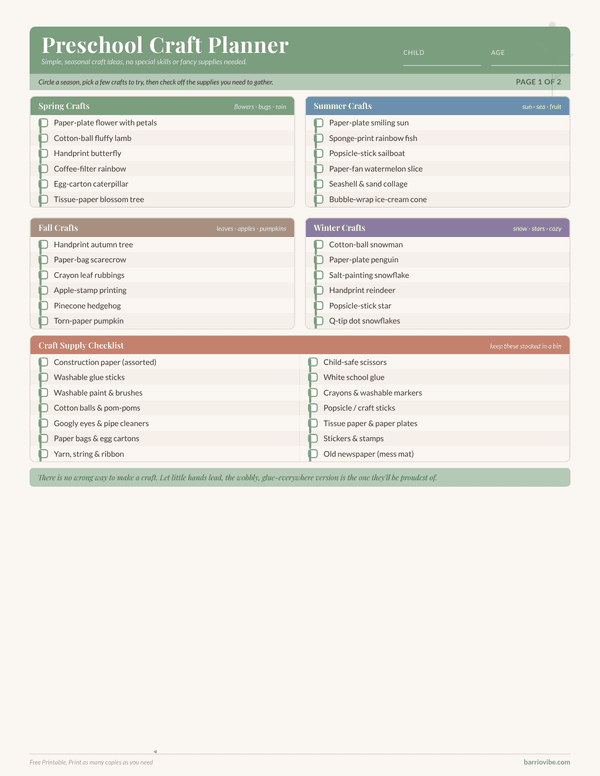
Preschool Crafts Idea Planner, Free Printable
A free printable preschool crafts planner with seasonal craft ideas, a craft supply checklist, and a weekly craft planner to organize easy at-home crafts for kids.
What are the best spring preschool crafts?
Spring preschool crafts follow the very same easy-and-seasonal formula, just swapped for warmer themes: flowers, rain, bugs, and baby animals. Reliable favorites include coffee-filter flowers colored with washable markers and spritzed with water, handprint butterflies, cotton-ball lambs, paper-plate rain clouds with dangling blue streamers, and egg-carton caterpillars. Just like fall, keep the steps few and the pieces big, and lean on things you already have on hand, coffee filters, paper plates, and clothespins do a surprising amount of the heavy lifting. Spring is also the perfect season to move crafting outside, where spills matter far less and kids can gather their own materials: dandelions, twigs, and fallen petals all become instant collage supplies. Rotating your crafts with the seasons gives children a gentle, hands-on sense of the calendar and keeps the same small stash of supplies feeling brand new. Pair a few spring ideas with your fall favorites and you've quietly covered most of the year with almost no extra shopping.
How do crafts help preschoolers learn?
Crafts do far more than fill an afternoon, they build the exact skills preschoolers need heading into kindergarten. Every time a child snips paper, they strengthen the hand muscles used for writing; every time they glue, stamp, or thread, they sharpen the fine-motor control and hand-eye coordination that eventually make holding a pencil possible. Choosing colors and arranging pieces builds early planning and decision-making, and following a two- or three-step craft is real practice at following directions. You don't need to turn craft time into a formal lesson, because the learning is already baked in. To stretch it further, narrate what's happening ("you're pressing the red apple down hard") to grow vocabulary, and let your child lead the choices to build confidence. If you want more ideas in this vein, our easy preschool craft ideas and planner covers year-round projects, and these summer preschool craft ideas keep the momentum going once the weather warms up.
Preschool Crafts Idea Planner, Free Printable
A free printable preschool crafts planner with seasonal craft ideas, a craft supply checklist, and a weekly craft planner to organize easy at-home crafts for kids.
Keep the planner where you actually plan the week, pick a couple of crafts, and let the season do the theming for you. The best craft time isn't the most impressive one, it's the one that actually happens.
Frequently Asked Questions
What are easy fall crafts for preschoolers?
Easy fall crafts for preschoolers include leaf rubbings with crayons, paper-plate pumpkins painted orange, handprint turkeys, apple stamping, and tissue-paper corn. Choose projects with three or four big steps, washable supplies, and no fine-detail cutting so little hands can manage the whole thing themselves.
What craft supplies do I need for preschool fall crafts?
A small core stash covers the season: washable paint in fall colors, construction and easel paper, a glue stick, child-safe scissors, crayons, markers, paper plates, cotton balls, and gathered nature bits like leaves and acorns. Buy washable versions to protect your table and their clothes.
How long should a preschool craft take?
Keep preschool craft sessions to about ten to fifteen minutes, since attention drifts after that. Setup should take under twenty minutes with three or four materials. Doing the fiddly prep ahead, pre-cutting shapes and portioning paint, keeps the actual craft short, focused, and low-stress.
At what age can kids start doing crafts?
Most children can enjoy simple crafts around age two, starting with whole-hand activities like stamping, dipping, and painting. By three and four, preschoolers can handle gluing, tearing, and basic scissor work with supervision. Match the craft to their skills by keeping steps few and pieces big.
Do crafts actually help preschoolers learn?
Yes. Crafts build the fine-motor control and hand-eye coordination preschoolers need for writing, plus early planning, color recognition, and following multi-step directions. Cutting strengthens hand muscles used for pencils, and narrating the activity grows vocabulary, so craft time doubles as kindergarten-readiness practice.