Some links in this guide are affiliate links, if you buy through them we may earn a small commission at no extra cost to you. Here’s our disclosure.
Quick Answer
The easiest way to declutter is to work one small zone at a time instead of a whole room. Start with obvious trash and duplicates, sort every item into keep, donate, or toss, and give what stays a permanent home. Use a room-by-room checklist so you always know the next step.
You walk into a room meaning to tidy for ten minutes, and forty minutes later you are standing in the middle of a bigger mess than you started with, a pile of "I'll deal with this later" in one corner, a bag of things to donate that has lived by the front door for three weeks, and a junk drawer you opened, stared at, and quietly closed again. The clutter is not there because you are lazy or disorganized. It is there because every single item asks you to make a decision, and making a hundred decisions at once is genuinely exhausting. So the stuff stays, the piles migrate from room to room, and the whole house starts to feel like one long unfinished to-do list you carry around in your head all day. If that loop sounds familiar, the fix is not a marathon weekend or a total life overhaul, it is something much smaller and more repeatable.
What are the best decluttering ideas to start with?
The best decluttering ideas start small and specific: pick one drawer, one shelf, or one countertop instead of a whole room. A contained space gives you a fast, visible win in under fifteen minutes, and that quick payoff is what builds the momentum to keep going. Begin with the easiest decisions first, obvious trash, expired products, and duplicates you did not know you owned, because clearing those shrinks the pile and clears your head before you hit the harder, sentimental choices. Work with three simple categories from the very start: keep, donate, and toss. Avoid the "maybe" pile; it is just decluttering you will have to redo later. The goal of your first session is not a perfect home. It is proof that fifteen focused minutes visibly changes a space, the single realization that turns decluttering from a dreaded project into a habit you repeat.
It also helps to treat decluttering as editing, not organizing. You are not hunting for clever ways to store more stuff; you are deciding what earns a place in your home. Fewer things means less to clean, less to shuffle, and less to think about, so every future tidy-up gets faster. The simplest decluttering ideas are the ones you will actually repeat, so start with one easy win today and let the confidence carry you into the next.
How do you declutter room by room without getting overwhelmed?
Declutter one room at a time, and within each room work one zone at a time, never the whole house at once. Overwhelm comes from trying to hold the entire project in your head, so the fix is to narrow your focus until each task is small enough to finish in a single sitting. Assign each room a couple of high-impact zones, clear those, and call the room "done for now" even if a closet still waits its turn. This room-by-room printable checklist breaks the whole house into exactly those bite-sized zones so you always know the next move.
| Room | Start-here zones |
|---|---|
| Kitchen | Countertops, junk drawer, expired pantry items |
| Bathroom | Medicine cabinet, under-sink, expired products |
| Bedroom | Nightstand, dresser top, under the bed |
| Closet | Hangers, shoe pile, "someday" clothes |
| Living room | Coffee table, media console, toy overflow |
| Entryway | Mail pile, shoe bin, coat hooks |
Cross off a zone the moment it is clear, visible progress is the fuel that keeps a whole-house declutter moving. If a room feels too big even in zones, shrink the target again: one shelf of the pantry, one basket of toys. There is no zone too small to count. Keep a donate box and a trash bag in the room with you as you work, so decisions turn into action on the spot instead of into fresh piles you have to sort a second time.
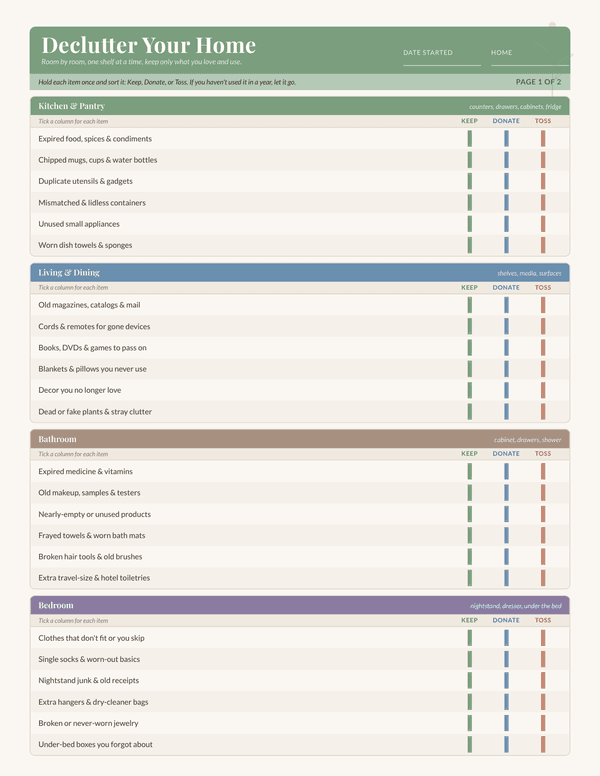
Declutter Your Home Checklist, Free Printable
A room-by-room decluttering checklist with Keep, Donate, and Toss columns plus twelve 20-minute declutter zones, so you can clear the clutter from your whole home one shelf at a time.
What's the fastest way to declutter in 20 minutes?
The fastest way to declutter is a timed 20-minute sprint aimed at one small zone, because a hard stop forces quick decisions instead of endless deliberating. Set a timer, choose a single target, one shelf, the coat closet, or that overflowing junk drawer, and race the clock. Speed is the point: the timer removes the option to overthink each item, and most clutter decisions are genuinely obvious once you stop second-guessing them. Try these quick decluttering ideas when you only have a spare 20 minutes:
- Empty and edit one drawer, dump it out, toss the trash, and return only what belongs.
- Clear one flat surface, counters and tables attract clutter fastest, so reset them first.
- Fill one donate bag, walk the house grabbing anything you no longer use or love.
- Tackle the "doom pile", that one chair or corner where everything seems to land.
When the timer goes off, stop. Twenty honest minutes beats a two-hour session you keep postponing. String a few sprints together across a week and a surprising amount of ground gets covered without a single overwhelming afternoon. Keep a running list of 20-minute targets on the fridge so you never waste the timer wondering where to begin, you just grab the next one and go.
How do you decide what to keep, donate, or toss?
Sort every item into one of three actions the moment you pick it up, keep, donate, or toss, and never set anything down in a "decide later" pile. The decision gets easier when you ask one honest question: have I used this in the past year, and would I bother to replace it if it were gone? If the answer is no, it goes. Keep only what you use, need, or genuinely love; donate what is usable but no longer yours; toss what is broken, expired, or missing pieces. Sentimental items are the hardest, so save them for last, when your decision-making muscle is warmed up, and give yourself a small, honest limit, one memory box, not five.
| Action | What goes here |
|---|---|
| Keep | Used in the last year, needed, or truly loved |
| Donate | Usable and in good shape, but not for you |
| Toss | Broken, expired, incomplete, or unsafe |
The three-action rule keeps you moving so clutter never piles back up mid-sort. When you get stuck on an item, put the burden of proof on keeping it rather than on letting it go. Instead of asking "could I ever use this?", where the answer is almost always a reluctant yes, ask "do I actually use this now?" That single reframe clears far more than any storage trick, and it is the quiet heart of decluttering that lasts.
How do you keep clutter from coming back after you declutter?
Give every kept item a permanent home, because clutter returns whenever things have nowhere to belong. Once a category is pared down, decide exactly where it lives and store like with like, so the system is obvious to everyone in the house, not just to you. Contain small, loose items in clear bins or labeled baskets so a single glance tells you what is inside and where it goes back; a simple label maker turns a decent system into one the whole family can actually maintain. Then protect the reset with a one-in, one-out rule: something new comes in only when something old goes out. Build in a five-minute nightly reset to return stray items to their homes before they multiply overnight.
Watch the doorways, too, mail, packaging, and freebies are how clutter sneaks back in fastest, so deal with the mail the day it arrives and break down boxes before they colonize the entryway. If you want the full walkthrough, our guide on how to declutter and organize your whole home pairs these maintenance habits with a room-by-room organizing plan, so the calm you worked for actually sticks around.
What should you do with everything you declutter?
Move it out of the house fast, the longer donate bags and toss piles sit by the door, the more likely the clutter creeps back in. Schedule the exit the same day you sort: load donations into the car right away and drop them at a charity shop on your next errand, or book a free donation pickup so you never touch the pile twice. Take out the trash and recycling immediately, sell anything genuinely valuable within the week, and pass usable items to friends or a local "buy nothing" group. The rule is simple: the item leaves your home within a few days, not a few months.
And do not let "I'll sell it" become its own form of clutter, if something has not sold in two weeks, donate it and move on, because the point is a lighter home, not a side hustle managing outgoing piles. If you would rather knock it all out at once, our weekend decluttering plan maps a two-day route through the whole house. Grab the room-by-room checklist below, start with one small zone, and let each crossed-off box carry you to the next.
Declutter Your Home Checklist, Free Printable
A room-by-room decluttering checklist with Keep, Donate, and Toss columns plus twelve 20-minute declutter zones, so you can clear the clutter from your whole home one shelf at a time.
Frequently Asked Questions
Where do I start decluttering when the whole house feels overwhelming?
Start with one small, contained zone like a single drawer or countertop, not a whole room. A quick win in under fifteen minutes builds the momentum to keep going. Clear obvious trash and duplicates first, then move to the next zone using a room-by-room checklist.
What is the keep, donate, toss method?
It is a three-action sorting rule: as you pick up each item, decide immediately whether to keep it, donate it, or toss it. Keep what you use or love, donate what is usable but not yours anymore, and toss what is broken or expired. Skip the 'maybe' pile entirely.
How do I decide what to keep when decluttering?
Ask one honest question about each item: have I used this in the past year, and would I replace it if it were gone? If the answer is no, let it go. Put the burden of proof on keeping the item rather than on getting rid of it.
How do I stop clutter from coming back after I declutter?
Give every kept item a permanent home and store like with like so the system is obvious to everyone. Use a one-in, one-out rule, do a five-minute nightly reset, and deal with incoming mail and packaging the day they arrive before they pile up again.
How long does it take to declutter a room?
You do not have to do it all at once. Most rooms clear in a few focused 20-minute sprints spread across a week, each aimed at one zone. A timed sprint forces quick decisions, so you cover far more ground than in a single exhausting marathon session.