Some links in this guide are affiliate links, if you buy through them we may earn a small commission at no extra cost to you. Here’s our disclosure.
Quick Answer
The cleaning tips and tricks that actually work reduce friction: clean as you go, work top to bottom and dry to wet, keep color-coded microfiber cloths where you use them, let cleaners dwell before wiping, and anchor a short daily reset to a habit you already have so it runs on autopilot.
You wipe the counters, run the vacuum, spray something that smells like lemons, and two days later the house looks exactly like it did before you started. It is a discouraging loop: you feel like you are always cleaning, yet the home never quite feels clean. Meanwhile the cabinet under the sink is stuffed with half-used sprays that promised miracles and delivered streaks, and the tricks you saved from a dozen videos never seem to fit your real, cluttered, lived-in rooms. The problem is rarely that you are lazy or doing it wrong. It is that most cleaning advice is either too vague to use on a Tuesday night or too fussy to keep up. What you need are the small, repeatable moves that quietly make everything easier, the ones that pay off every single time, not just on camera.
What are the best cleaning tips and tricks that actually work?
The best cleaning tips and tricks all reduce friction, they make the right action the easy action, so cleaning happens without a fight. The highest-impact habits are simple: clean as you go instead of batching messes, work top to bottom so you never redo a surface, keep supplies where you use them, and let a timer decide when you are done. These beat any specialty gadget because they change the pattern, not just the tool. A few concrete winners: wipe the shower while you are still in it, run the dishwasher nightly even half-full, and do a five-minute "reset" of one room before bed. None of these are dramatic. That is the point, sustainable cleaning tricks are boring, low-effort, and repeatable. Flashy hacks fail because they demand a mood; quiet systems win because they demand almost nothing. Start with two or three of these and let them become automatic before adding more.
What cleaning supplies do you actually need?
Fewer than you think, most homes need one all-purpose spray, a glass cleaner, a bathroom cleaner, dish soap, and a good stack of microfiber cloths, and that covers roughly ninety percent of everyday messes. The single upgrade that changes the most is switching from paper towels and old rags to color-coded microfiber cloths: they lift dust and grime with water alone, leave no streaks, and last through hundreds of washes, which saves money over time and cuts down on the cabinet clutter. Assign a color to each zone, say, blue for glass, green for kitchen, and a separate color for the bathroom, so you never cross-contaminate. Keep a small caddy stocked per floor of your home so you are never hunting for supplies mid-task. Round it out with a scrub brush, a squeegee, and a good vacuum, and skip the single-purpose sprays that each clean one thing; they crowd your cabinet and rarely outperform a solid all-purpose formula used correctly.
In what order should you clean a room?
Work top to bottom and dry to wet, every time. Start by clearing clutter off surfaces so you have room to work, then dust from high to low, shelves, frames, and sills before tables, so anything you knock loose falls onto surfaces you have not cleaned yet. Next, wipe those surfaces, then handle wet tasks like counters and fixtures, and finish with the floor last so it catches every crumb and dust bunny you dislodged along the way. Cleaning in this order means you never redo a spot, which is where most wasted effort hides. The same logic scales to the whole house: clean the highest and driest rooms before the wettest, dirtiest ones like the bathroom and kitchen. One more time-saver: carry an empty basket and drop in everything that belongs elsewhere, then redistribute it in one trip at the end. Follow the sequence and a room that used to eat forty distracted minutes takes fifteen focused ones, because nothing gets undone.
How do you keep a house clean without cleaning all day?
Attach cleaning to a rhythm instead of a mood, a short daily reset plus one focus zone per day keeps a home tidy on about fifteen minutes a day, no marathon required. The daily part handles what snowballs fastest: dishes, counters, a quick tidy, and making the beds. The weekly part spreads the bigger jobs so no single day is heavy. When cleaning has a set order, you stop deciding what to tackle and simply follow the plan, which is what makes it stick through a busy week. The trick is to anchor the reset to a habit you already have, right after breakfast, or while coffee brews, so it runs on autopilot. Miss a day? You resume the next zone instead of restarting, because a routine you can fall off and climb back onto is the only kind that survives. If you want the whole rhythm mapped out for you, our weekly cleaning schedule printable lays out exactly what to do each day.
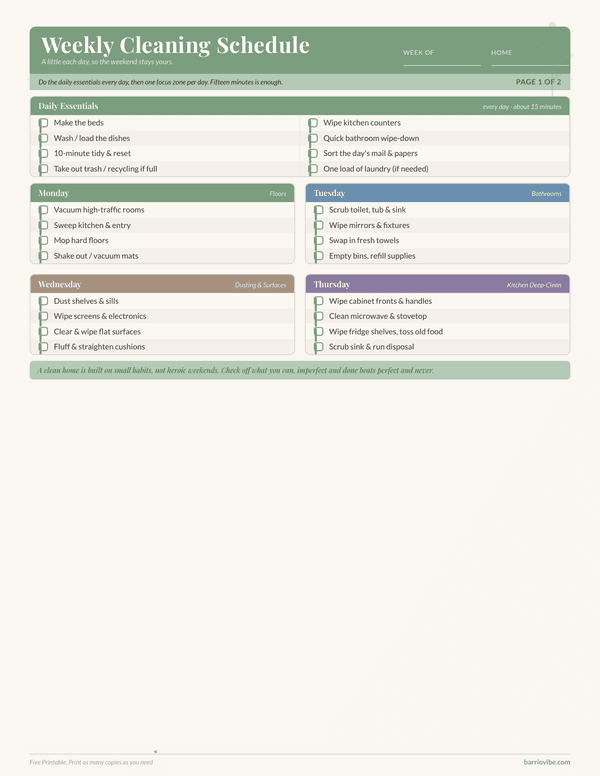
Weekly Cleaning Schedule, Free Printable
A realistic weekly cleaning schedule: a 15-minute daily-essentials checklist plus one focus zone per day, Monday through Sunday, with a weekly reset and progress summary. Print on standard letter paper.
What are the fastest cleaning hacks for a busy week?
Speed comes from removing steps, not moving faster, the quickest cleaning hacks let a product or a habit do the work while you do something else. Let cleaners dwell: spray the shower, toilet, or a greasy stovetop and walk away for ten minutes so the chemistry loosens the grime before you wipe, instead of scrubbing dry. Batch by motion, not by room, dust every surface in the house, then wipe every surface, so you are not constantly switching tools and doubling back. Clean the moment you notice a mess, too; a fresh spill wipes in seconds, while a dried one becomes a scrubbing project you will dread and postpone. Keep the wins visible with quick, targeted fixes:
| Problem | Fast trick |
|---|---|
| Microwave splatter | Steam a bowl of water and lemon 3 minutes, then wipe |
| Streaky glass | Buff dry with a clean microfiber, no spray residue |
| Musty-smelling sink | Grind a lemon wedge and ice in the disposal |
| Dusty blinds | Wipe with a damp microfiber over your hand |
| Sticky cabinet fronts | Warm water with a drop of dish soap |
| Water rings on faucets | Wrap in a vinegar-soaked cloth 10 minutes |
| Crumbs in tight corners | Loosen with a dry paint brush, then vacuum |
Set a fifteen-minute timer and race it, urgency turns a dreaded chore into a quick sprint, and knowing there is a hard stop makes it far easier to start.
What natural cleaning tricks actually work?
A few pantry staples genuinely clean, based on how they react chemically, not marketing. Distilled white vinegar cuts hard-water spots, mineral deposits, and soap scum because its acidity dissolves them; use it on glass, faucets, and showerheads, but keep it off natural stone like granite or marble, which it can etch. Baking soda works as a gentle abrasive and deodorizer: sprinkle it in the tub, on cooktops, or in the fridge to absorb odors. Together, a baking-soda scrub followed by a vinegar rinse tackles stubborn tub rings and slow drains. Lemon handles grease and leaves a clean scent, which makes it perfect for cutting boards and the disposal. The important caveat: never mix vinegar with bleach, and do not assume "natural" means "sanitizing", for germs on a cutting board or during illness, you still want a registered disinfectant. Used for the right jobs, these three cheap staples replace a shelf of specialty sprays.
Pick two or three tricks and make them automatic before adding more. For the deeper resets weekly maintenance does not reach, run our room-by-room deep cleaning checklist seasonally.
Weekly Cleaning Schedule, Free Printable
A realistic weekly cleaning schedule: a 15-minute daily-essentials checklist plus one focus zone per day, Monday through Sunday, with a weekly reset and progress summary. Print on standard letter paper.
Frequently Asked Questions
What is the most effective way to clean a house?
Clean in one consistent order: tidy clutter first, then work top to bottom and dry to wet, finishing with floors. This stops you redoing surfaces. Pair it with a 15-minute daily reset and one focus zone per day so no single cleaning session ever feels overwhelming.
What are the best natural cleaning tricks?
White vinegar dissolves hard-water spots and soap scum on glass and faucets; baking soda scrubs and deodorizes tubs and fridges; lemon cuts grease and freshens the disposal. Keep vinegar off natural stone, never mix it with bleach, and use a real disinfectant for germs.
How do I clean my house fast?
Remove steps instead of rushing. Let cleaners dwell 10 minutes while you do another task, batch by motion (dust everything, then wipe everything), carry a basket for out-of-place items, and set a 15-minute timer per room so urgency keeps you moving toward a clear finish line.
What cleaning supplies do I actually need?
Most homes need just one all-purpose spray, glass cleaner, bathroom cleaner, dish soap, and a stack of color-coded microfiber cloths, plus a scrub brush, squeegee, and vacuum. Skip single-purpose sprays that crowd your cabinet and rarely beat a good all-purpose formula used correctly.
In what order should you clean a room?
Declutter surfaces first, then dust from high to low, wipe surfaces, handle wet tasks like counters and fixtures, and clean the floor last. Cleaning floors at the end means any dust or crumbs you knocked down get picked up in the final step, so nothing gets undone.