Some links in this guide are affiliate links, if you buy through them we may earn a small commission at no extra cost to you. Here’s our disclosure.
Quick Answer
To deep clean a bathroom, work top to bottom and dry to wet. Dust high surfaces, then soak the shower, tub, and toilet with cleaner while you wipe the mirror, sink, and counter. Scrub the soaked areas, clean the toilet inside and out, and finish with the floor last.
You wipe down the counter, swish the toilet, and hang a fresh towel, and somehow the bathroom still feels grimy. There's a pink film creeping along the grout, the glass shower door has gone cloudy, and no amount of everyday tidying seems to touch the ring at the base of the toilet or the hard-water spots on the faucet. It's the room that gets used the most and cleaned the most superficially, so build-up hides in exactly the spots a quick wipe never reaches: under the rim, behind the taps, along the caulk line, and inside the exhaust fan. Humidity makes it worse, steam settles into the grout and caulk, feeding mildew faster than anywhere else in the house. If your bathroom looks tidy but never quite feels fresh, you're not cleaning wrong so much as cleaning shallow. A real reset needs a different approach, one that moves through the room in a deliberate order instead of dabbing at whatever looks worst.
How do you deep clean a bathroom, step by step?
Deep cleaning bathrooms works best from the top down and dry to wet, so nothing you clean gets dirty again on the way. Open a window or run the fan first so cleaning fumes don't build up as you work. Start by clearing everything off the counter, shower, and floor, then dust or wipe the high surfaces first, the exhaust vent, light fixtures, and the top of the mirror. Spray the shower, tub, and toilet with cleaner and let them soak while you work elsewhere; time is what breaks down soap scum, not scrubbing. Wipe cabinet fronts and the mirror, then move to the sink and counter. Come back to the now-soaked shower and tub, scrub, and rinse. Clean the toilet inside and out, and finish with the floor, sweeping first, then mopping your way toward the door. Working in this order means dust, hair, and drips all fall onto the floor, which you clean last. One deliberate pass beats three frantic ones.
Where should you start when the bathroom is really dirty?
Start with the tasks that clean themselves while you work: the toilet bowl, the shower, and the tub. Squirt bowl cleaner under the rim, spray the shower walls and tub with a bathroom cleaner or a paste of baking soda and dish soap, and walk away for ten to fifteen minutes. That soak does the heavy lifting on soap scum and mineral build-up, so you scrub far less. While those sit, tackle the dry work up high, cobwebs in corners, dust on the exhaust fan cover, smudges on light fixtures, because anything you knock loose should fall onto surfaces you haven't cleaned yet. Next, empty the trash and set any rugs, mats, and the shower curtain liner into the wash. Starting this way means that by the time you circle back to the shower and toilet, the products have already loosened the grime, and your job becomes a quick scrub-and-rinse instead of a workout.
How do you deep clean a shower, tub, and grout?
The secret to a clean shower and tub is dwell time, not elbow grease. Coat the surfaces with your cleaner, a vinegar-and-dish-soap mix for soap scum, an oxygen-bleach paste for grout and caulk, and let it sit ten to fifteen minutes before you touch it. For grout lines and corners, a stiff grout brush or an old toothbrush reaches what a sponge can't; work the paste in, let it dwell, then rinse. Cloudy glass doors respond to the same vinegar solution followed by a squeegee. For mildew stained into the caulk itself, press a vinegar-soaked paper-towel strip along the line and let it sit. Don't forget the parts people skip: the showerhead (unscrew it or tie a bag of vinegar around it overnight to dissolve mineral clogs), the tracks of a sliding door, and the underside of the tub's rim. Rinse everything thoroughly so no residue is left to attract new grime, then dry the fixtures with a cloth to keep water spots from forming.
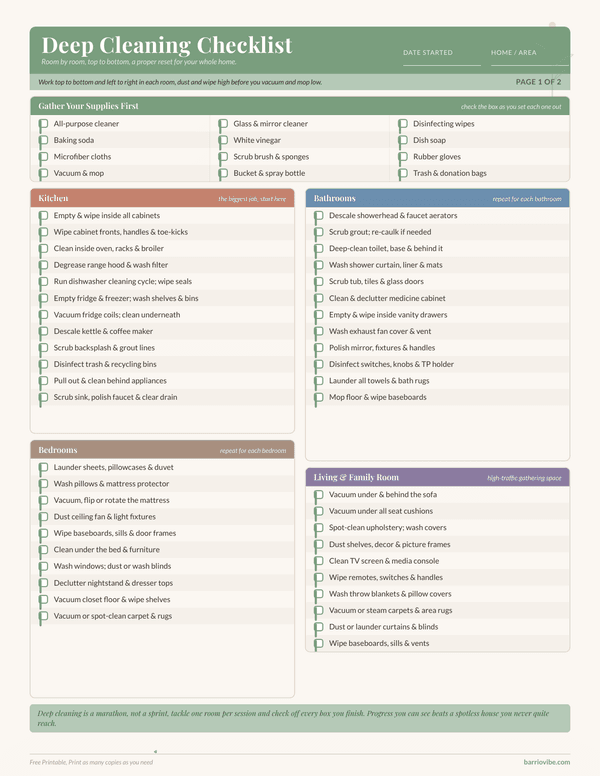
Deep Cleaning Checklist, Free Printable
A room-by-room deep cleaning checklist for your whole home, with tick-box tasks for the kitchen, bathrooms, bedrooms, and every other room, plus a supplies list and the often-missed spots. Print it out and work through one room at a time for a top-to-bottom house reset.
How do you get the toilet and the area around it truly clean?
A truly clean toilet means going beyond the bowl to the spots that actually hold odor: the base, the hinges, and the floor around it. Start inside, let bowl cleaner sit under the rim, then scrub with the brush, getting up into the rim jets where mineral streaks hide. For the outside, spray a disinfectant and wipe from the tank down, paying attention to the flush handle, the hinge caps where the seat attaches, and the often-missed area behind the bowl. The base, where porcelain meets floor, is where odor-causing residue collects, so wipe it with a disinfecting cloth and get into the caulk line. Finish by cleaning the floor around and behind the toilet, not just the open areas. If the seat hinges are grimy, pop the covers and clean underneath. Finally, disinfect the toilet brush and its holder themselves, they're often the dirtiest item in the room. This is the difference between a bathroom that smells clean and one that only looks it.
What supplies make deep cleaning a bathroom faster?
The right small kit turns a two-hour chore into a forty-minute one. You don't need a specialty product for every surface, all-purpose cleaner, white vinegar, baking soda, and a disinfectant cover almost everything. What saves the most time is having the right applicators on hand so you're not improvising: a set of color-coded microfiber cloths (one color for glass, another for the toilet, so nothing cross-contaminates), a stiff grout brush, and a squeegee for glass. Keep them in a caddy stored right in the bathroom so a deep clean never starts with a scavenger hunt, and restock it the moment something runs low so deep cleaning bathrooms never stalls halfway through. Work zone by zone rather than task by task, finish one area completely before moving on, so you're not circling the room a dozen times. Once it's spotless, a few bathroom organization ideas keep the counters clear so the next clean is even quicker. Here's a simple zone breakdown to work through:
| Zone | Deep-clean tasks |
|---|---|
| Ceiling & walls | Dust vent cover, wipe light fixtures, clear cobwebs, spot-clean walls |
| Shower & tub | Soak, scrub grout and caulk, descale showerhead, squeegee glass |
| Toilet | Under-rim jets, exterior, hinges, base, floor behind |
| Sink & counter | Faucet, drain, backsplash, clear and wipe surfaces |
| Mirror & fixtures | Polish glass, wipe handles and switch plates |
| Floor | Sweep, then mop edges and behind the toilet last |
How often should you deep clean a bathroom?
Most bathrooms need a deep clean every one to two weeks, with a quick daily wipe in between. A bathroom used by a whole family, or one with poor ventilation, collects grime faster and leans toward the weekly end; a rarely used guest bath can go a month. The trick with deep cleaning bathrooms is separating maintenance from the deep work: a thirty-second daily swipe of the sink and a squeegee of the shower door after each use keep soap scum and water spots from ever building up, which keeps your bi-weekly deep clean fast. Between deep cleans, spot-treat problems as you notice them, mildew on caulk, a ring starting in the bowl, rather than waiting. If you fold the bathroom into a broader whole-home routine, like our room-by-room deep cleaning checklist, the recurring version fits neatly onto a schedule so it never piles up again. Print the checklist below, keep it under the sink, and work through it top to bottom.
Deep Cleaning Checklist, Free Printable
A room-by-room deep cleaning checklist for your whole home, with tick-box tasks for the kitchen, bathrooms, bedrooms, and every other room, plus a supplies list and the often-missed spots. Print it out and work through one room at a time for a top-to-bottom house reset.
Frequently Asked Questions
How do you deep clean a bathroom that hasn't been cleaned in a while?
Start by spraying the shower, tub, and toilet and letting them soak 10 to 15 minutes so the products break down build-up for you. Then work top to bottom, dust high surfaces, wipe the mirror and counter, scrub the soaked areas, clean the toilet, and mop the floor last.
What is the best homemade cleaner for a bathroom deep clean?
White vinegar cuts soap scum and hard-water spots, while a paste of baking soda and dish soap scrubs tubs and sinks. For grout and caulk, use an oxygen-bleach paste. Avoid mixing vinegar with bleach, and always run the fan or open a window while you clean.
How long does it take to deep clean a bathroom?
A standard bathroom takes about 45 minutes to an hour when you let cleaners soak while you work other areas. A bathroom that's been neglected can take closer to 90 minutes. Keeping supplies in a caddy and working zone by zone rather than task by task saves the most time.
How do you clean grout and get rid of mildew?
Apply an oxygen-bleach or baking-soda paste to the grout, let it dwell 10 to 15 minutes, then scrub with a stiff grout brush and rinse. For mildew stained into caulk, press a vinegar-soaked paper-towel strip along the line and let it sit before scrubbing.
In what order should you clean a bathroom?
Clean top to bottom and dry to wet: dust high surfaces first, then mirrors and cabinet fronts, then the sink and counter, then the soaked shower and tub, then the toilet, and finish with the floor. This way anything you knock loose lands on surfaces you haven't cleaned yet.