Some links in this guide are affiliate links, if you buy through them we may earn a small commission at no extra cost to you. Here’s our disclosure.
Quick Answer
A goal planner printable is a fill-in page that turns vague resolutions into an action plan: it sorts your goals by life area, breaks each one into quarterly milestones and a monthly focus, and adds a habit tracker for daily follow-through. Pick just two or three goals, print it, and review it once a month.
Every January starts the same way. You buy the fresh notebook, you make the list, you feel that clean-slate rush, and then somewhere around the third week of February the list is buried under permission slips and grocery receipts, and you cannot even remember what you wrote on it. It is not that you do not want the things on that page. You genuinely want the calmer mornings, the finished projects, the money quietly building in savings. But wanting is not a plan, and a page of vague intentions gives you nothing to actually do on an ordinary Tuesday. The goal sits there, enormous and shapeless, so you keep putting off the first step until the whole thing feels like a failure you would rather not think about. So by spring you have quietly filed this year in the same drawer as last year's, telling yourself you will get serious next January, that next time will be different, that next time you will finally stick with it. If that cycle sounds exhausting and familiar, the problem was never your discipline or your ambition. It was that someone handed you a blank page and told you to change your life on it, with no map for how a single year is supposed to get you there.
What makes a goal planner printable different from a resolutions list?
A goal planner printable is different from a resolutions list because it turns a vague wish into a dated, broken-down system you can act on. A resolutions list stops at the wish, "get healthy," "save money", and leaves you to figure out the how. A goal planner printable keeps going: it sorts your goals by life area, assigns each one a quarterly milestone and a monthly focus, and adds a habit tracker for the daily actions that get you there. The difference is structure. A wish lives in your head, where it competes with everything else and usually loses; a written, dated goal becomes a commitment with a next step attached. If you like to reflect before you plan, this New Year resolutions worksheet helps you decide what matters most this year, and our New Year goals printable makes a lighter one-page companion to the full planner below.
Why do most goal planners fail by February?
Most goal planners fail by February because they ask you to set too many goals with no system to revisit them. On January 1 the enthusiasm is real, so you write a dozen ambitious goals across every part of your life at once. But a dozen goals means a dozen things competing for attention, and none of them gets enough of yours to move. Then the planner slides into a drawer, the second, quieter failure, because nothing ever tells you to look at it again. Goals you never re-read might as well not exist. The planners that actually last do two things differently: they cap you at two or three goals so your focus is not shredded across a wish list, and they build in a monthly review so the plan stays in front of your face. Ambition sets the target; a small number of goals and a regular check-in are what actually carry you to it. The version of you who succeeds in December is not more motivated than the version who quits in February, she just built a plan that kept reminding her what to do next.
How do you set goals by life area instead of one giant list?
Set goals by life area so your ambition stays balanced instead of piled onto one corner of your life. When every goal is about work, the rest quietly slides; sorting by area keeps you honest about the whole picture. A goal planner printable breaks the year into a handful of core areas so nothing important gets forgotten:
| Life area | Example goal |
|---|---|
| Health & energy | Walk 20 minutes most days |
| Home & organization | Declutter one zone a month |
| Money | Build a $1,000 buffer |
| Relationships | A weekly phone-free family dinner |
| Growth & learning | Read one book a month |
| Rest & fun | Plan one real day off each month |
The catch: choose only two or three goals total to lead the year, not two or three per area. Write the rest down anyway, capture them as "someday" so they stop rattling around in your head, but keep this year's energy pointed at a short, winnable list. Fewer goals is not lowering the bar; it is aiming the same effort at a target small enough to actually hit, so by December you have real finished things to show instead of a dozen half-started ones.
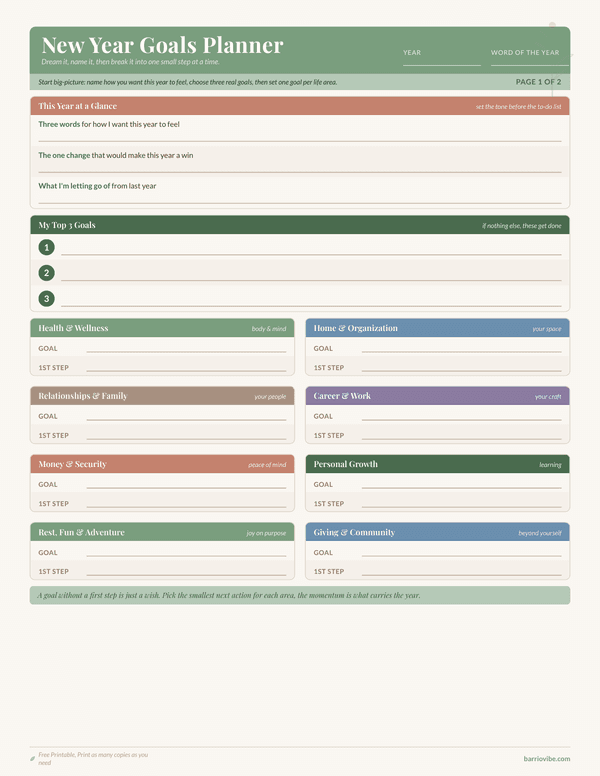
New Year Goals Planner, Free Printable
A two-page New Year goals planner to set goals by life area, map quarterly milestones and a monthly focus, and track your habits all year. Print it free and start the year with a clear plan.
How do you break a yearly goal into quarterly and monthly steps?
Break a yearly goal into quarterly and monthly steps by working backward from the finish line to this week. A goal like "save $1,000" feels too big to act on directly, but it becomes obvious the moment you divide it: about $250 a quarter, roughly $85 a month, a little over $20 a week. Do the same with any goal, a quarterly milestone tells you whether you are on pace, a monthly focus tells you what to prioritize right now, and a weekly action tells you what to actually do next. Reverse-engineering like this does two things at once. It shrinks an intimidating year into steps small enough to start today, and it gives you early warning: if the first quarter's milestone slips, you adjust in March instead of discovering in December that the whole year quietly got away. The printable gives you a column for each layer, so every big goal lands as a concrete next step. Suddenly the goal is not "save $1,000 someday" but "move $20 to savings this Friday", a task small enough that you have no excuse not to do it, and one that quietly stacks toward the number you wrote in January.
How do you track progress and build the habits behind your goals?
Track progress by attaching each goal to a daily or weekly habit and marking it somewhere you cannot ignore. Goals are outcomes; habits are the inputs that produce them, so a habit tracker is where a plan quietly turns into results. Choose one keystone habit per goal, a daily walk, a Sunday money check-in, ten minutes of reading, and check a box every single time you do it. Watching a chain of checked boxes grow builds its own momentum; you start not wanting to break the streak. Keep the tracker visible: slip your printable into a sheet protector and mark it with a set of dry-erase markers so you can reuse the same page all month without reprinting. Anchor each habit to something you already do, reading after the kids are down, the money check-in with your Sunday coffee, so it happens on autopilot. Missed a day? Do not restart the streak; just check the next box.
What should you review each month to stay on track?
Review your goals once a month, on a set date, so the plan stays alive instead of forgotten in a drawer. A monthly review is short, fifteen minutes with your goal planner printable and a cup of coffee. Ask three questions: What moved forward this month? What stalled, and why? What is the one focus for next month? Update your habit trackers, celebrate the milestones you actually hit, and rewrite anything that is not working, a goal that no longer fits deserves a revision, not a silent abandonment. This monthly rhythm is the single habit that separates people who finish their year from people who file it away in February. It is also where a small win becomes fuel: crossing off a milestone reminds you the system is working, which makes the next month easier to start. Add a longer quarterly review every three months to check your bigger milestones and reset your focus. Put the review date on your calendar right now, because the plan only works if you keep looking at it. A goal you revisit is a goal you reach.
New Year Goals Planner, Free Printable
A two-page New Year goals planner to set goals by life area, map quarterly milestones and a monthly focus, and track your habits all year. Print it free and start the year with a clear plan.
Print it, fill in your two or three goals, and put it somewhere you will see it every single day, the fridge, the inside of a cabinet, the corner of your desk. A year you actually plan is a year you actually finish, one small checked box at a time.
Frequently Asked Questions
What is a goal planner printable?
A goal planner printable is a fill-in sheet that turns broad resolutions into a workable plan. It sorts your goals by life area, breaks each into quarterly milestones and a monthly focus, and includes a habit tracker so you can mark the daily actions that move each goal forward.
How many goals should I set for the year?
Choose just two or three goals to lead the year, not one per category. A short list keeps your focus from being shredded across a dozen competing priorities. Capture every other idea as a "someday" note so it is recorded, then point this year's energy at the few that matter most.
What is the best way to break down a yearly goal?
Work backward from the finish line. Split a yearly goal into a quarterly milestone, then a monthly focus, then a weekly action. Saving $1,000, for example, becomes about $250 a quarter, $85 a month, and $20 a week, small enough to start today and easy to check your pace against.
Why do most goal planners stop working by February?
Most planners fail because people set too many goals and never revisit them. A dozen goals split your attention until none moves, and a planner left in a drawer might as well be blank. Capping your list and scheduling a monthly review are what keep a plan alive past February.
Do I need to print a new goal planner every month?
You do not have to. Many people slip the sheet into a sheet protector and mark it with a dry-erase marker, wiping the habit tracker clean at the start of each month. Others reprint monthly to keep a written record of their progress. Either approach works, pick whichever you will actually maintain.